Namibia was a first for me in more than one sense. I had never been to Africa — not to the Africa of open land and infinite distance, the kind that doesn't resemble anywhere else on earth. The trip had been in the back of my mind for a while, but the timing had to be right: we were traveling as a family, with two young daughters, and that changes the calculation considerably. You want wilderness, but you also want a margin of safety. You want immersion, but you also need the logistics to hold.
Namibia answered all of it. It is one of the few places on the continent where self-driving with children is not only feasible but genuinely the right way to go — the roads are manageable, the distances are long but predictable, and the infrastructure along the main routes is reliable enough to plan around. What drew me beyond the practical was the variety: Namibia is not one landscape but multiple ones, stacked against each other in a country the size of France and Spain combined. Desert, dune, coast, granite massif, open savanna, floodplain.
The route
- 1 Windhoek
- 2 Kalahari Desert
- 3 Sesriem / Namib
- 4 Sossusvlei
- 5 Swakopmund
- 6 Walvis Bay
- 7 Erongo Mountains
- 8 Twyfelfontein
- 9 Vingerklip
- 10 Etosha — Halali
- 11 Etosha — Okaukuejo
- 12 Waterberg Plateau
- ↩ Windhoek (return)
Day by day
Windhoek — Day 1
Windhoek is a logistical stop, not a destination. The city has the bones of a small modern capital — glass office buildings, western brand shops, wide roads — but it wears its contradictions openly. Within a few hundred meters of the commercial center, children approach cars at traffic lights asking for food. It is not a sight you forget.
The car rental was its own small ritual. Our 4×4 came equipped with two spare tires — standard issue in a country where gravel roads are the norm and punctures are not a matter of if but when — and a built-in fridge, which immediately reframed the logic of a road trip.
On the drive from the airport into the city, we saw some baboons just off the road, close enough to watch without stopping. Unhurried, indifferent, utterly at home.
Dinner that first evening surprised us. The restaurant would have held its own in any European city: the produce good, the cooking serious, the service attentive. Namibia has a way of confounding expectations early, and then repeatedly.
Kalahari Desert — Day 2
The road south-east from Windhoek empties quickly and the landscape takes over. No buildings, no infrastructure. Only dry nature.
Along the road, the iconic picture under the Tropic of Capricorn sign is a reminder of how far you are from home.
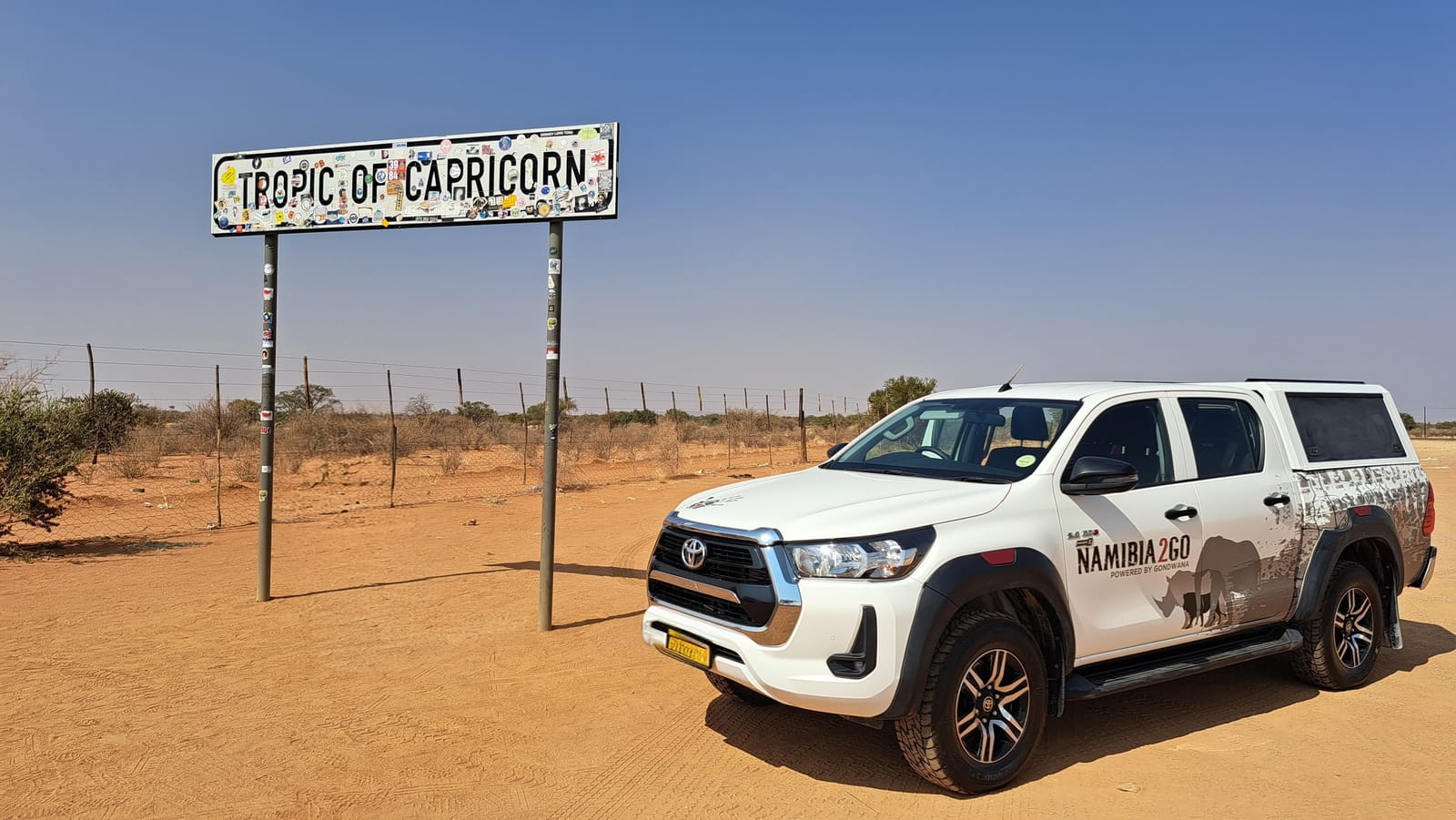
The journey, even if mostly on asphalt, was longer than expected. An unplanned stop at the Tilda Viljoen Dam near Gobabis gave us the feeling of the biggest challenge of this country: water.
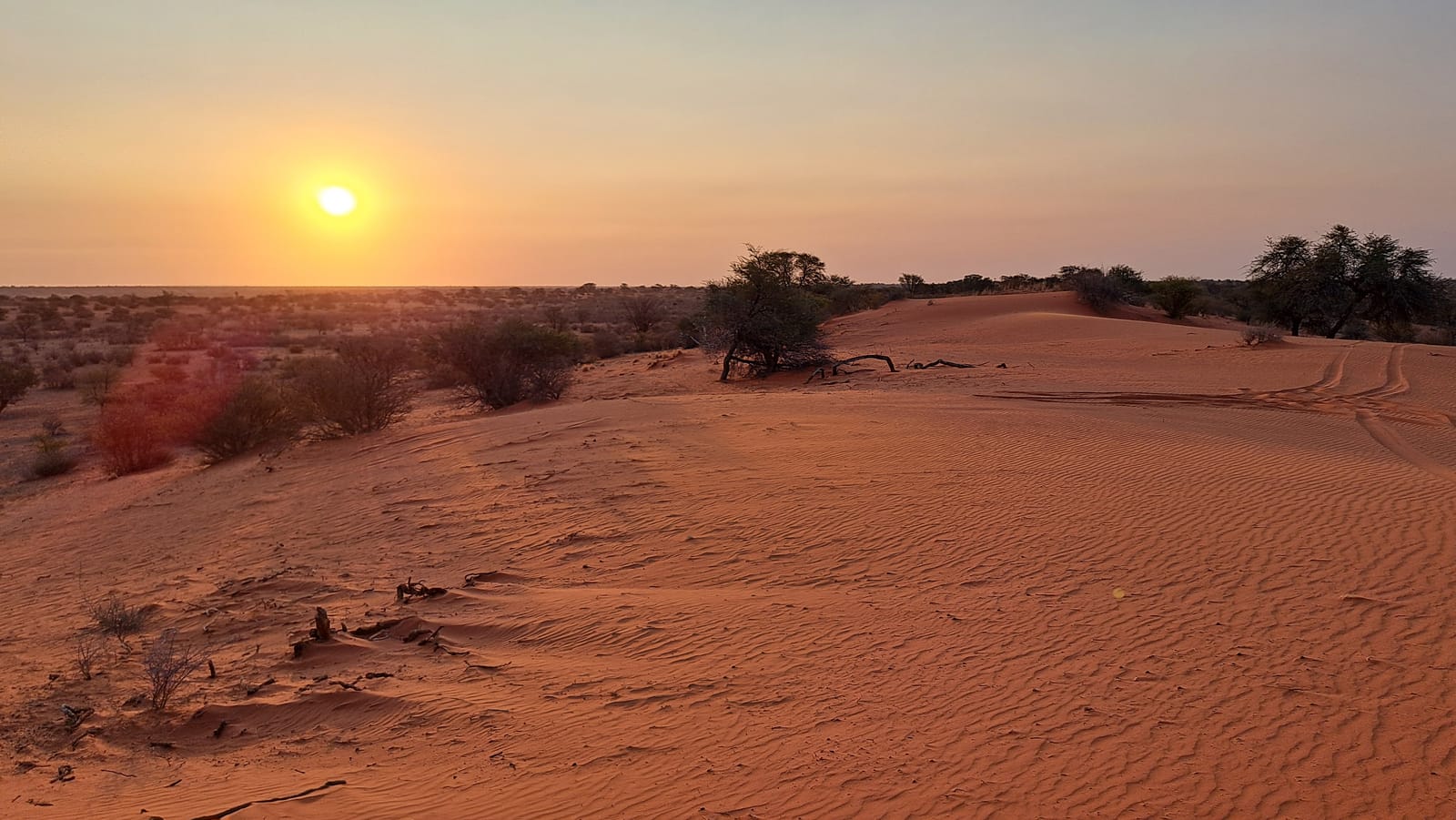
Finally we arrived at the Kalahari. Not a fully dry desert, but a red sandy land with green patches where wildlife can be easily spotted.
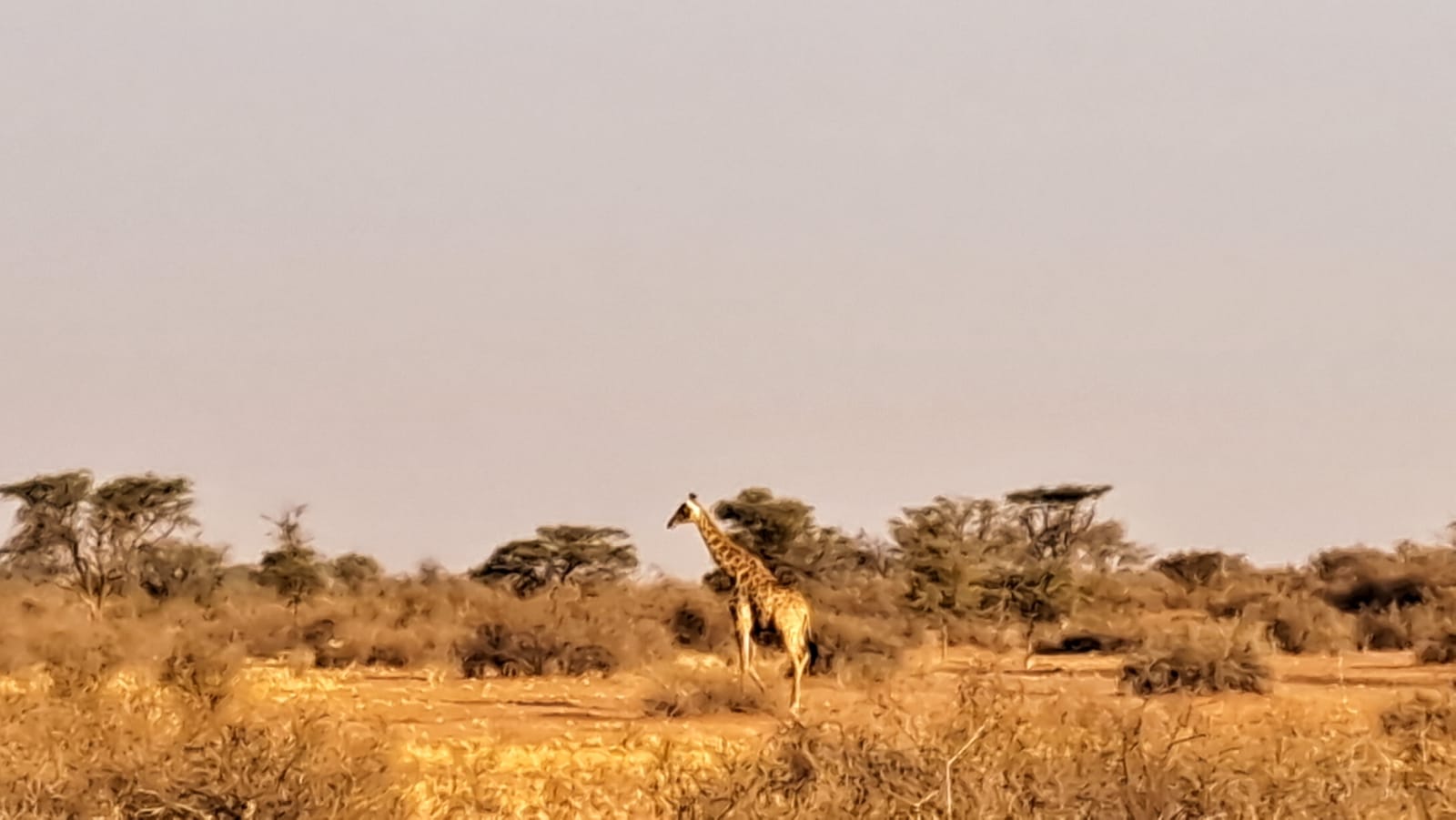
We stayed at a tented camp just inside the Transfrontier Park. A guide took us out at dusk in an open vehicle. When we saw our first giraffes, my older daughter kept repeating "like in a documentary" — and that was the best reward for having brought my family so far from home.
Sesriem — Day 3
The drive from the Kalahari to Sesriem is long and stark. The red sand of the Kalahari gives way gradually to harder, paler ground — gravel plains, flat and featureless for hours, apart from the occasional traveler stopped at the roadside repairing a flat tire.
The transition into the Namib happens without announcement. The gravel plain simply becomes drier, the vegetation thins to almost nothing, and then the dunes appear on the horizon — a low orange line at first, easily mistaken for a trick of the light. Then the road curves and they are unmistakable: enormous, asymmetrical, stacked against each other in colors that shift from deep terracotta to near-white depending on where the sun is.
Sesriem itself is just a gate and a cluster of lodges. But the late afternoon light as we arrived — low, lateral, turning everything amber — made it clear we were in a different place entirely.
After dinner, in the kind of darkness only desert nights can offer, the flat tire was ours.
Sossusvlei & Dead Vlei — Day 4
The park gate opens at sunrise, and the logic is simple: the dunes at first light are a different place from the dunes at nine in the morning. But before any of that, an earlier alarm. The flat tire from the night before needed to be left at a petrol pump for repair before we could enter the park — so the day started in the dark, with a detour, running on the spare.
The 60-kilometer track into the Sossusvlei basin is driven in the gray half-light before color returns to the world. At the end of the paved road, there is a 2WD parking area — the last point where ordinary vehicles can go. Beyond it, five kilometers of deep sand lead to the vleis, navigable only by 4×4. A shuttle covers that final stretch for those who need it. We took it, and it was the right call: on the way back, several self-drivers had buried their vehicles to the axles in the sand, and the road had become a recovery operation.
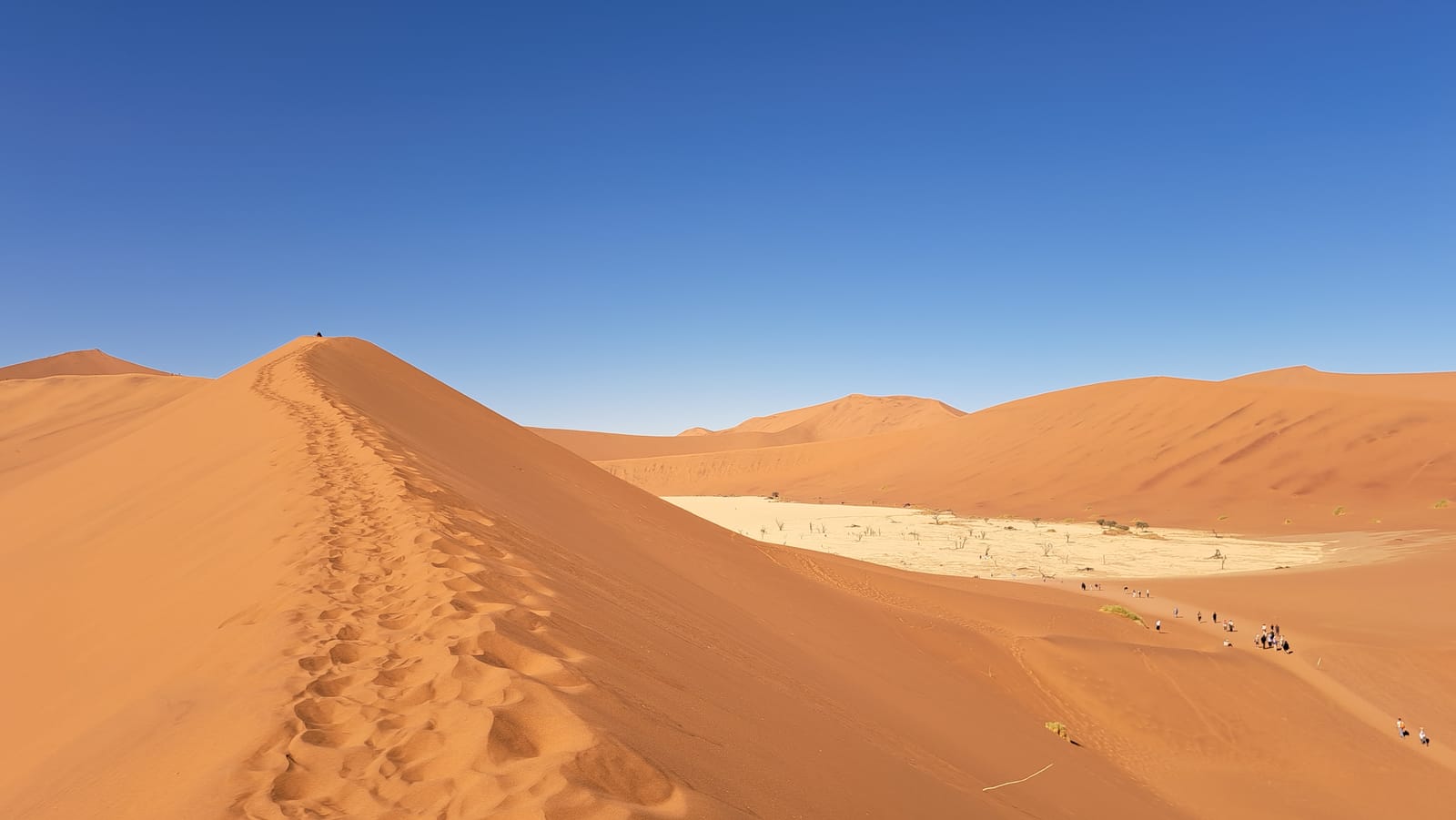
Dead Vlei came to us rather than the other way around. A flat white clay pan, ringed on three sides by dunes that in places reach 300 meters, with the blackened skeletons of camel thorn trees still standing in positions they occupied 900 years ago — when the river that fed this place was cut off by an advancing dune. They did not fall. The climate is too dry for decomposition. They simply stand: petrified, precise, almost architectural.
We climbed one of the dunes. The ridge is narrow and the sand shifts underfoot with every step, but the view from the top makes the effort self-explanatory.
On the way back we stopped at Sesriem Canyon, a short detour near the camp. A slot canyon carved by the Tsauchab river into the surrounding rock — worth a look, though after the scale of the morning, nothing was going to compete.
Swakopmund & Walvis Bay — Days 5–7
The drive from Sesriem to Swakopmund is the longest single day behind the wheel of the trip. The Namib stretches north-west without concession — gravel plain, sparse scrub, a road that asks nothing of you except to keep going.
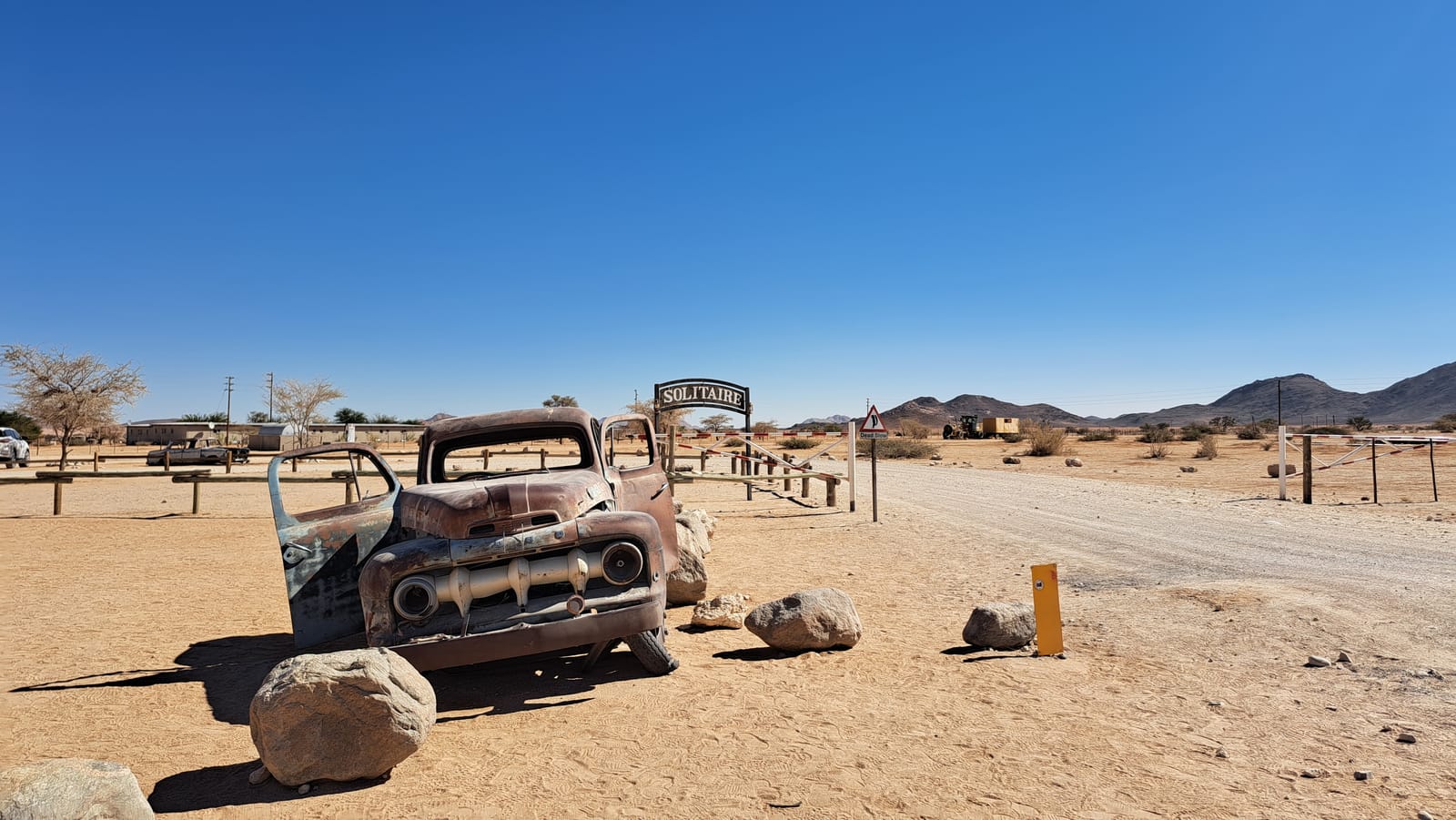
The one stop is Solitaire, and it is either a tourist trap or a piece of living history, depending on your tolerance for that distinction. A handful of buildings in the middle of absolutely nothing: a petrol pump, a bakery, and a scattering of rusted vehicle carcasses arranged outside the entrance with the quiet confidence of outdoor sculpture. The apple pie is warm, the coffee is hot, and the temperature outside is above 35 degrees. We stopped anyway. So did everyone else.
The approach to the coast announces itself before the sea is visible. Within a few hundred meters, the blue sky closes over and a thick coastal mist moves in — the Benguela fog that rolls off the cold Atlantic and sits over the Namib shore for much of the year. The temperature drops. The light flattens. After days of hard sun and red sand, it feels like arriving on a different planet.
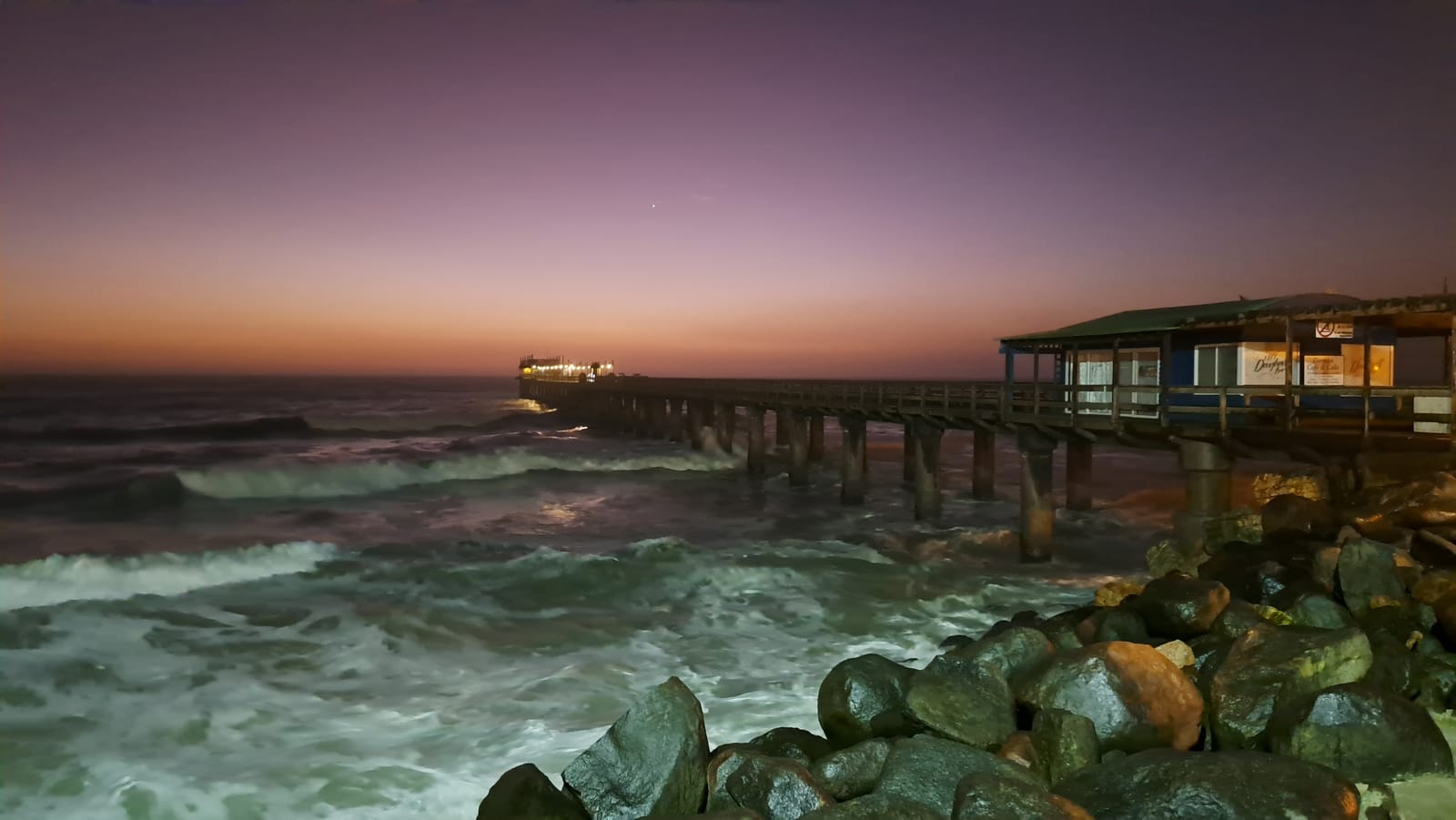
Swakopmund confirms the impression. A German colonial town — art nouveau facades, wrought iron balconies, street names in German — sitting on the South Atlantic coast of southern Africa. The contrast is so complete it takes a day to stop noticing it. We had dinner at a restaurant built at the end of a wooden pier, the ocean moving beneath the boards. The walk out over the water as the sun dropped was, on its own, worth the detour.
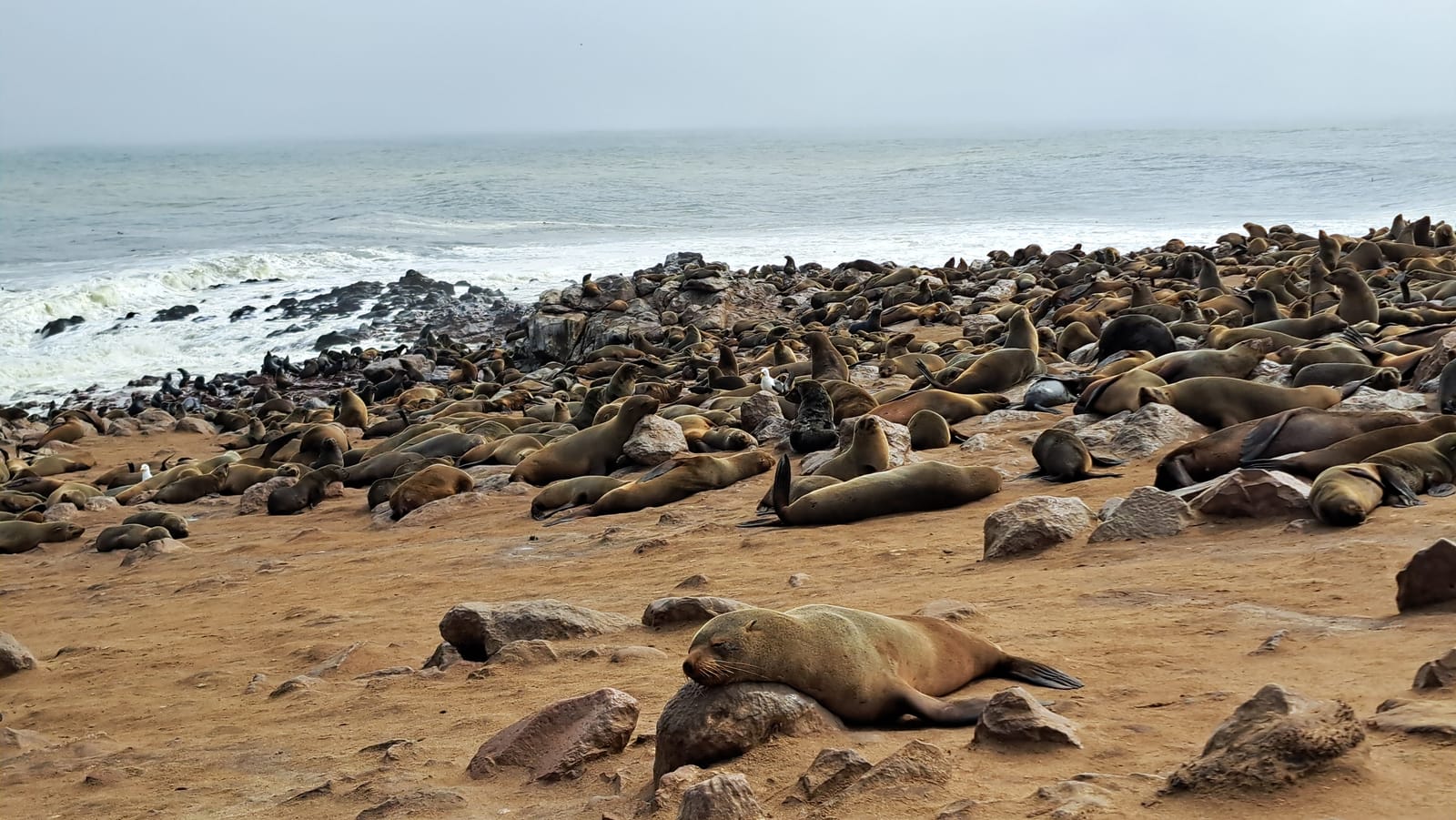
The following morning began with our second flat tire of the trip — dealt with before breakfast, with the efficiency that comes from having already done it once. Then north to Cape Cross. It was not our first seal colony, but nothing quite prepares you for the scale of it — thousands of Cape fur seals covering every inch of the shoreline, moving, calling, piled on top of each other in a continuous mass of noise and motion. The smell reaches you well before the seals do, and it does not leave you for some time after. Overwhelming is not too strong a word. It felt, again, like being inside a documentary — except the smell confirmed otherwise.
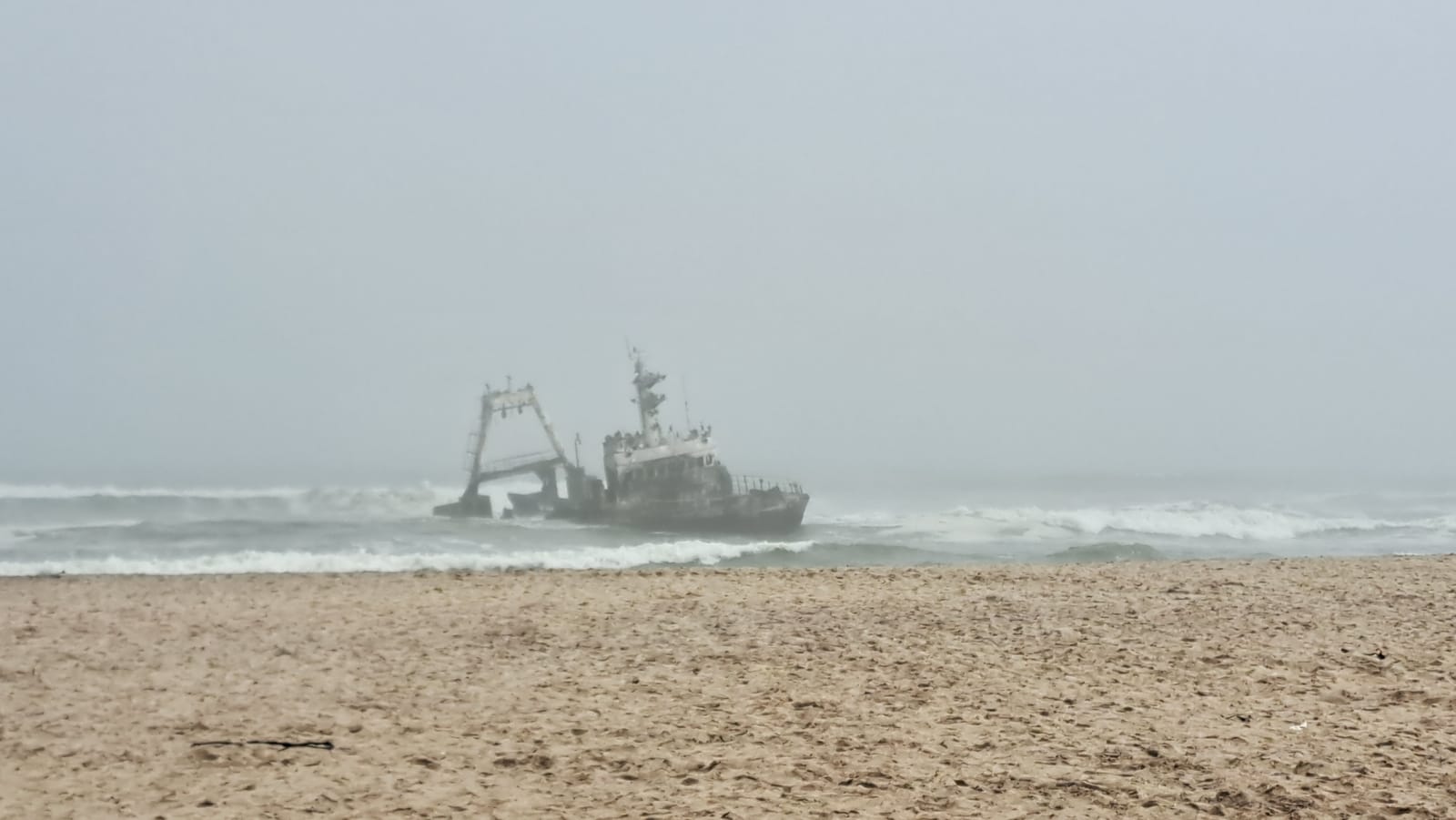
On the way back, the wrecks along the Skeleton Coast emerged from the mist in the way they were always meant to be seen: half-visible, listing into the surf, the fog doing most of the work. We stopped for photographs and did not linger.
Back in Swakopmund, a walk through the town in the afternoon — the German facades, the cold air off the sea, the strange coherence of a place that should not exist and yet has settled entirely into itself.
The last full day split into two very different halves. The morning was a boat cruise on Walvis Bay — organized, touristic, and initially feeling like it might disappoint. Then the whales arrived, and not quietly: full breaches, the entire head clearing the water before falling back with a noise you feel as much as hear. Everything before it becomes preamble.
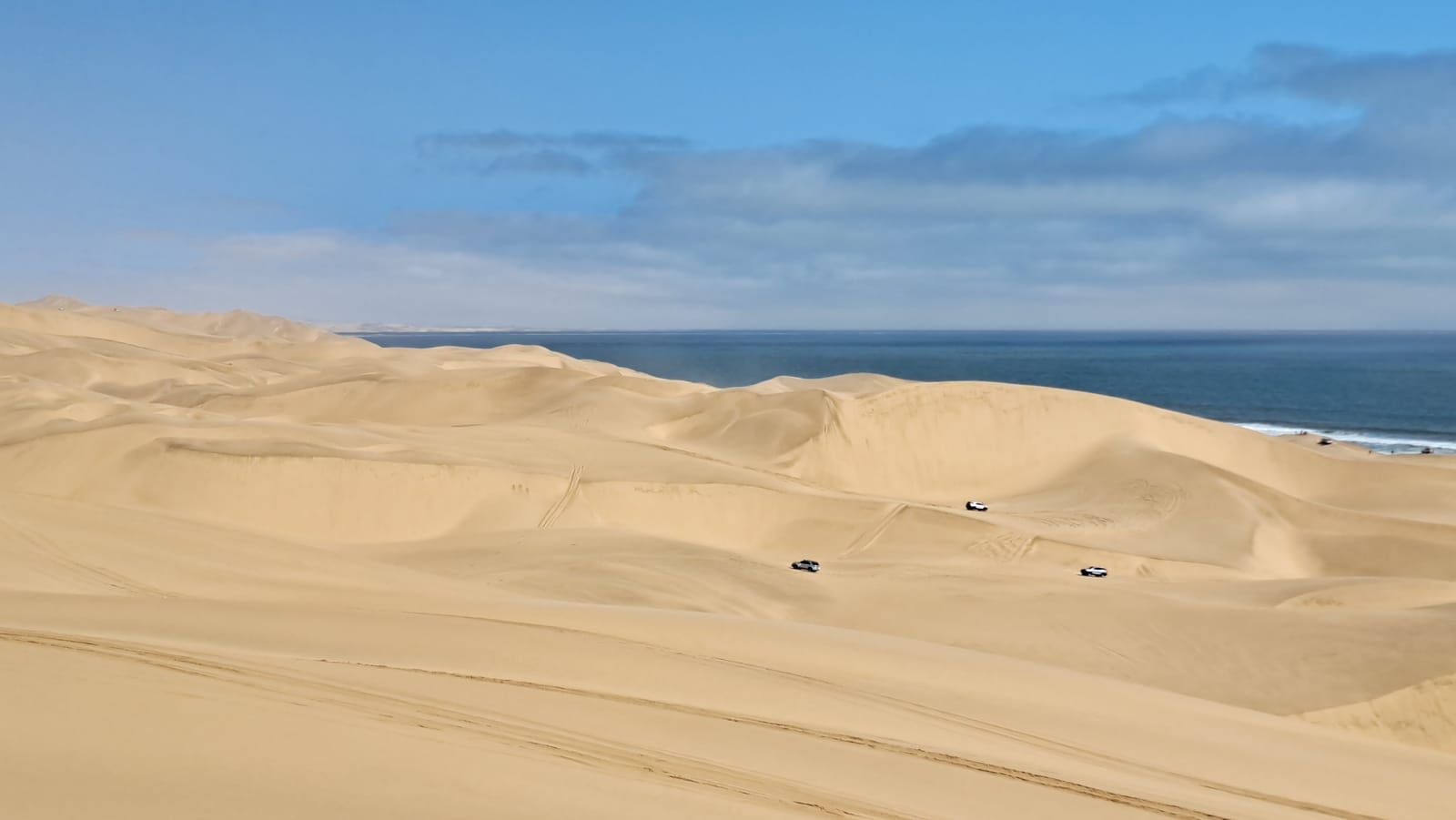
The afternoon was a 4×4 excursion into the Namib south of Swakopmund — expensive, organized, unambiguously worth it. This is not the Namib of Sesriem. The sand here is pale yellow rather than terracotta, the dunes are enormous and uninterrupted, and they end not in a gravel plain or a clay pan but directly in the Atlantic. The ocean simply begins where the dune stops. There is no transition, no beach in any conventional sense — just sand and then sea. Three vehicles picking their way along the crest, the water sixty meters below.
Erongo Mountains — Day 8
Leaving Swakopmund means leaving the fog behind almost as quickly as it arrived.
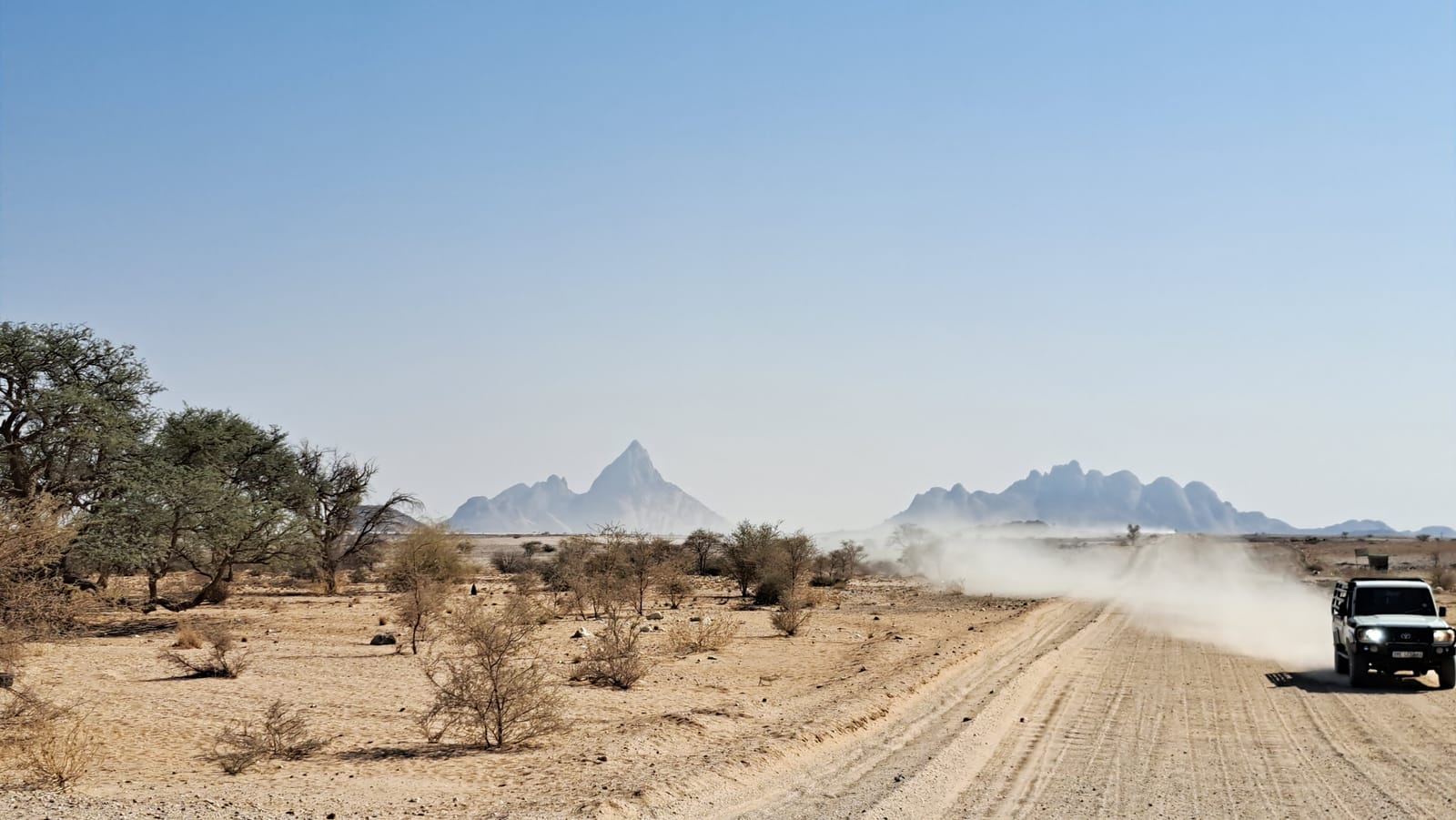
The Erongo Mountains announce themselves from a distance: a warm gray granite massif rising abruptly out of the surrounding plain, clearly visible through the dust thrown up by the few cars we passed.
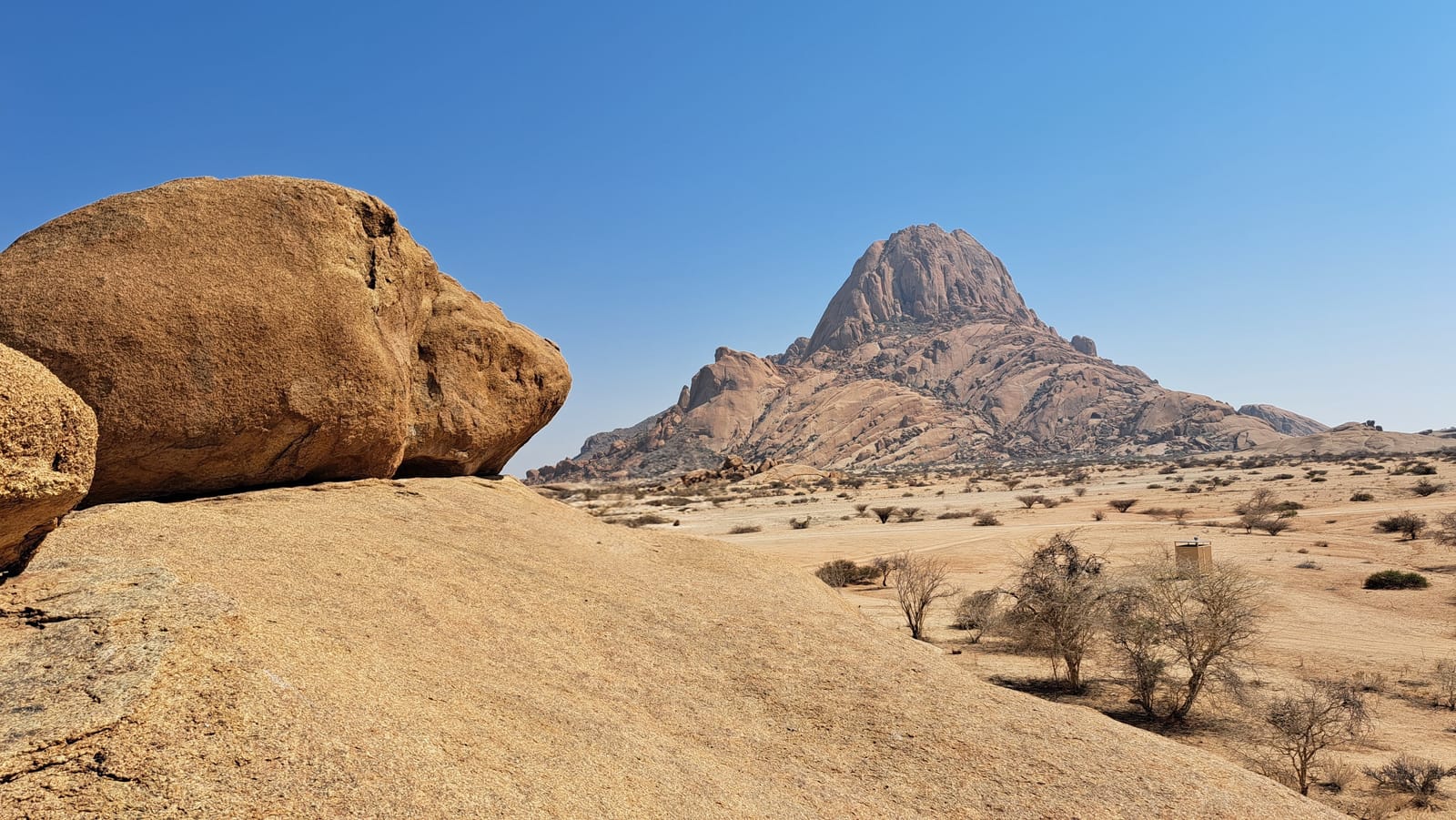
Up close, the range turns strange. Enormous boulders, rounded by time into shapes that look deliberate, balanced against each other at impossible angles. Natural arches and rock bridges appear where erosion has worked through the granite for millions of years, carving openings you can walk beneath or climb through. The area sees far fewer visitors than the main circuit further south, and it shows — no queues, no crowds, just the rock and the silence.
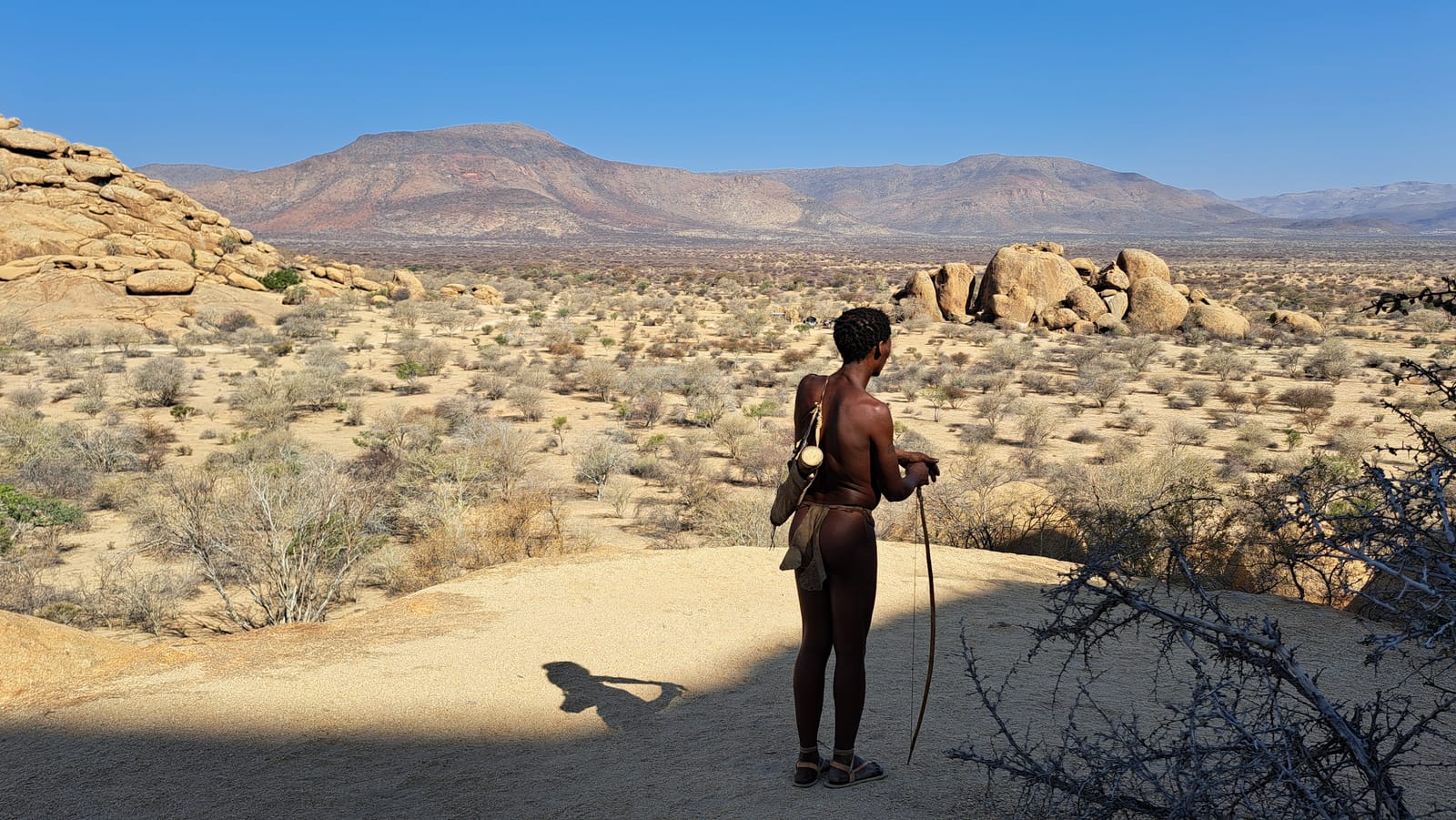
Before reaching the guest farm, we stopped at a local San living museum. The visit was genuinely interesting — a chance to understand something of a culture built around tracking, bow-hunting, and an intimate, practical knowledge of the bush that has nothing in common with how the rest of us relate to land. The walk out with a tracker produced an unexpected encounter: a giraffe at close range, on foot, no vehicle between us. It changes the register entirely. You feel the size of the animal in a way a game drive never quite delivers.
The guest farm itself had an uneasy kind of charm. Run by a couple of European origin with African staff supporting the operation, it had the warmth of genuine hospitality and, at the same time, an unmistakable echo of an older colonial arrangement that nobody mentioned. The farm itself was a green pocket in an otherwise dry, hard landscape — irrigated grounds, shade trees, a garden that had no business existing in that climate and existed anyway.
Damaraland & Twyfelfontein — Day 9
Just enough time for a fiery sunrise, then back on the dusty road.
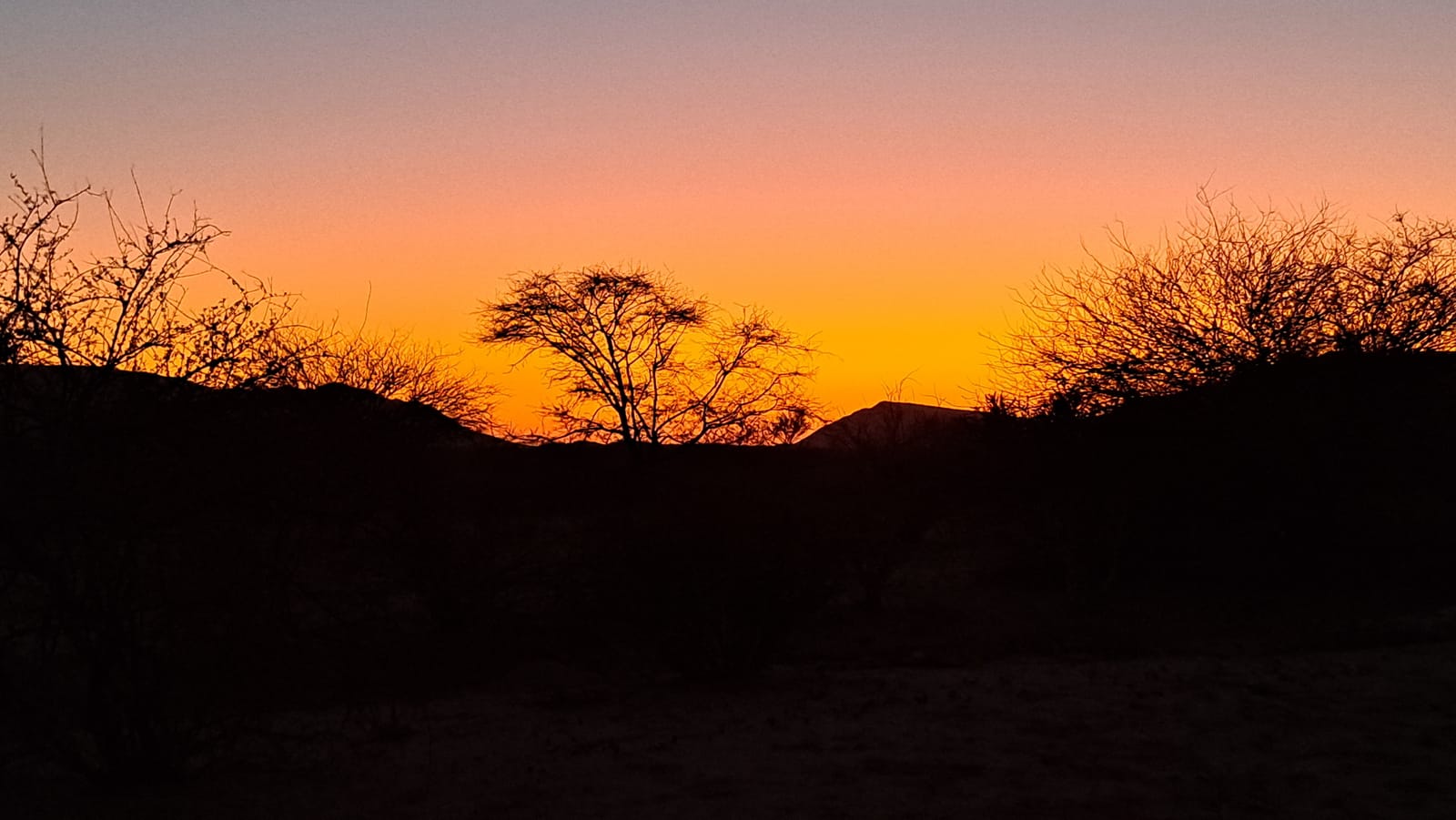
The road north out of the Erongo runs below the Brandberg — at 2,573 meters, Namibia's highest mountain, an isolated granite dome rising out of the plains with a sudden authority that makes it feel designed rather than geological. We did not stop, but it held the horizon for the better part of an hour.
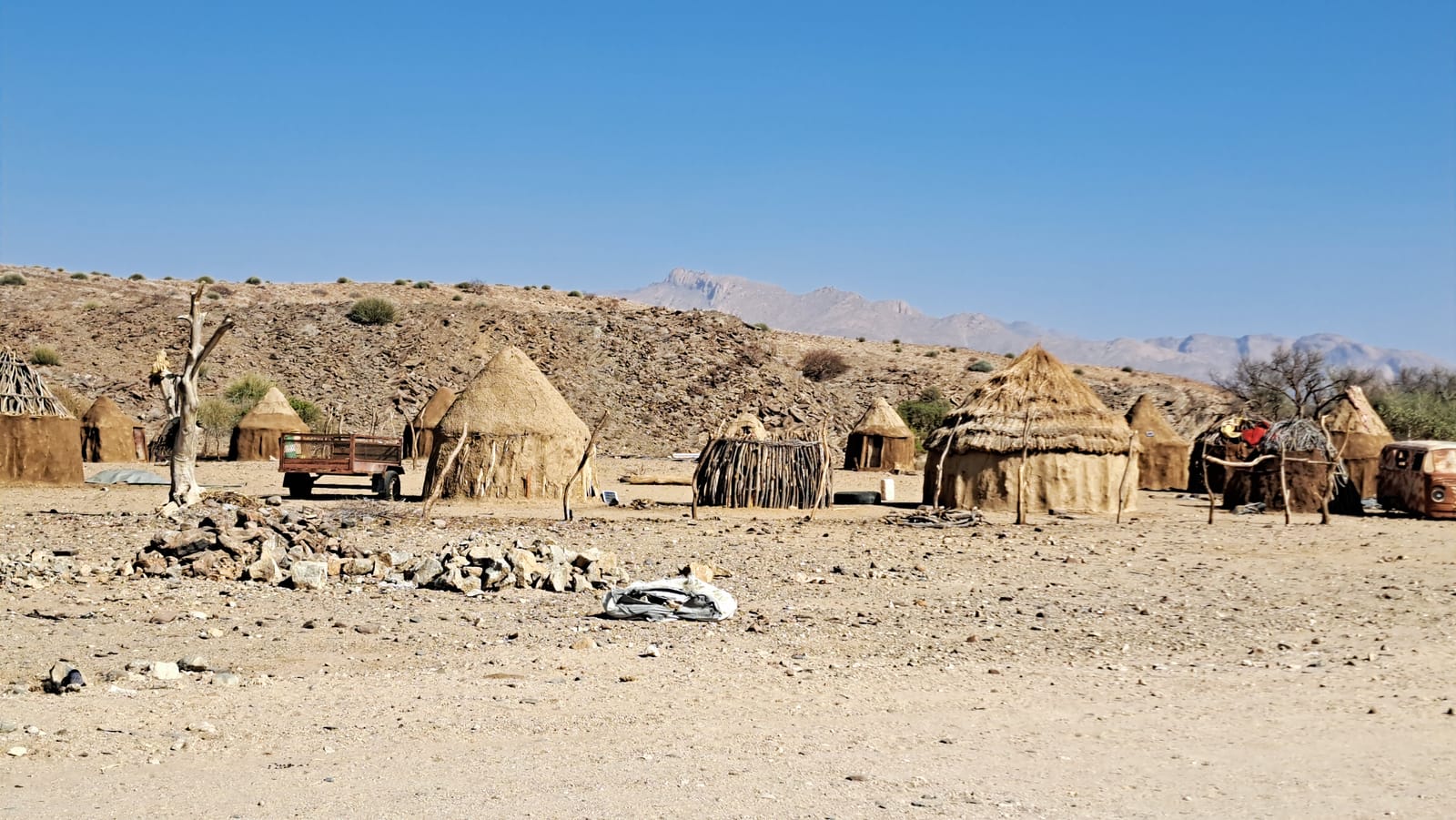
Further on, a brief stop at a Himba settlement near the road. These encounters require some care: much of northern Namibia has built a tourist economy around staged versions of indigenous life, and the difference between that and something genuine is not always obvious from the road. This felt like the latter — a community living on its own terms, extending a welcome that was clearly theirs to give or withhold. The Himba are semi-nomadic pastoralists, cattle and goat herders, and the women's distinctive ochre-and-fat skin preparation is often photographed without context. In context, it is simply how they live.
The afternoon destination was Twyfelfontein — a UNESCO World Heritage Site on a sandstone slope, holding more than 2,500 rock engravings made by San hunter-gatherers over a span reaching back as far as 6,000 years. What you are looking at is not primitive art. It is documentation.
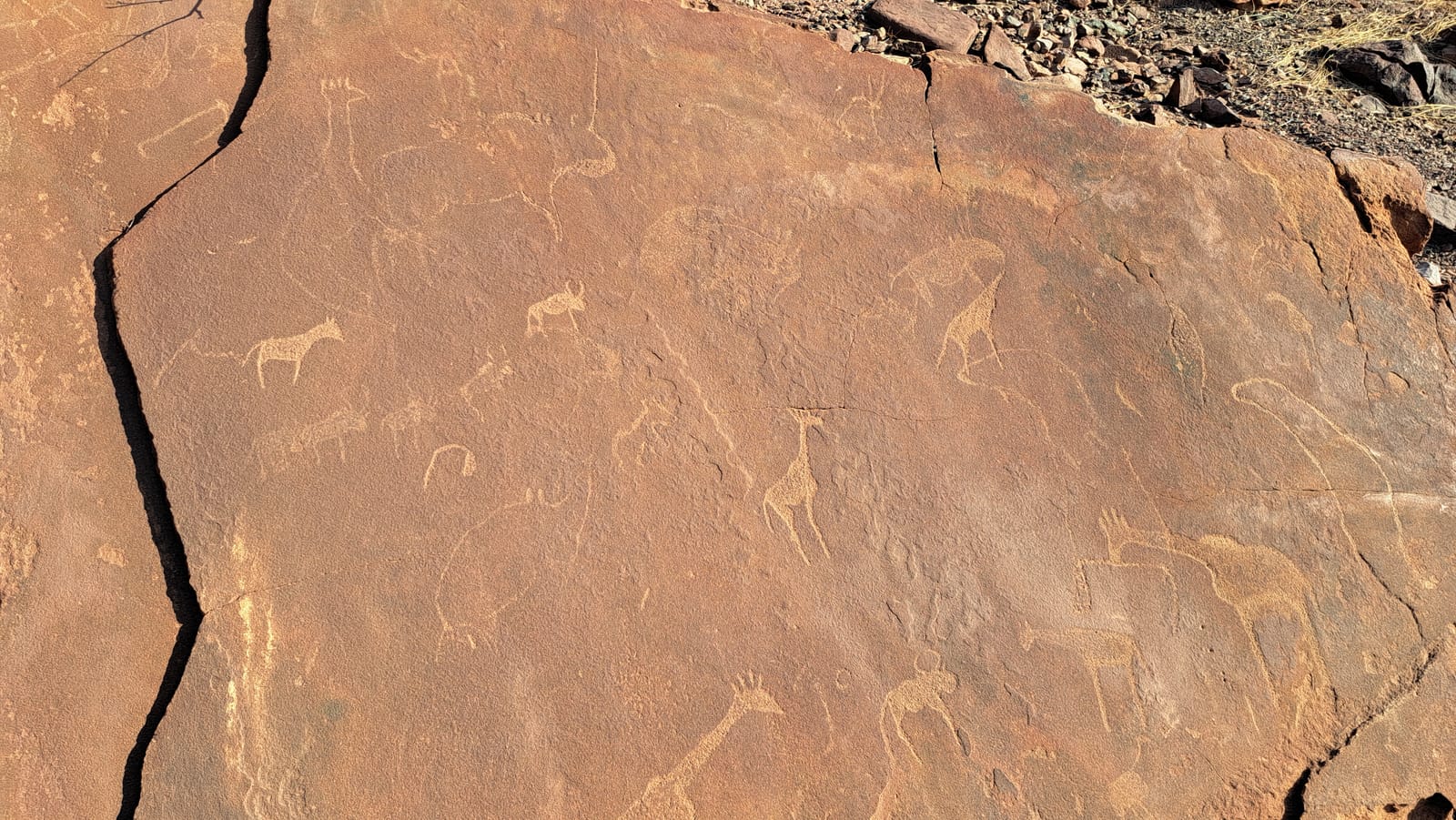
A year later, my younger daughter opened her history textbook at school and found these exact engravings reproduced on the page. The pleasure on her face, recognizing a place she had actually stood in, was worth more than anything I could have told her about it in advance.
Vingerklip & Desert Elephants — Day 10
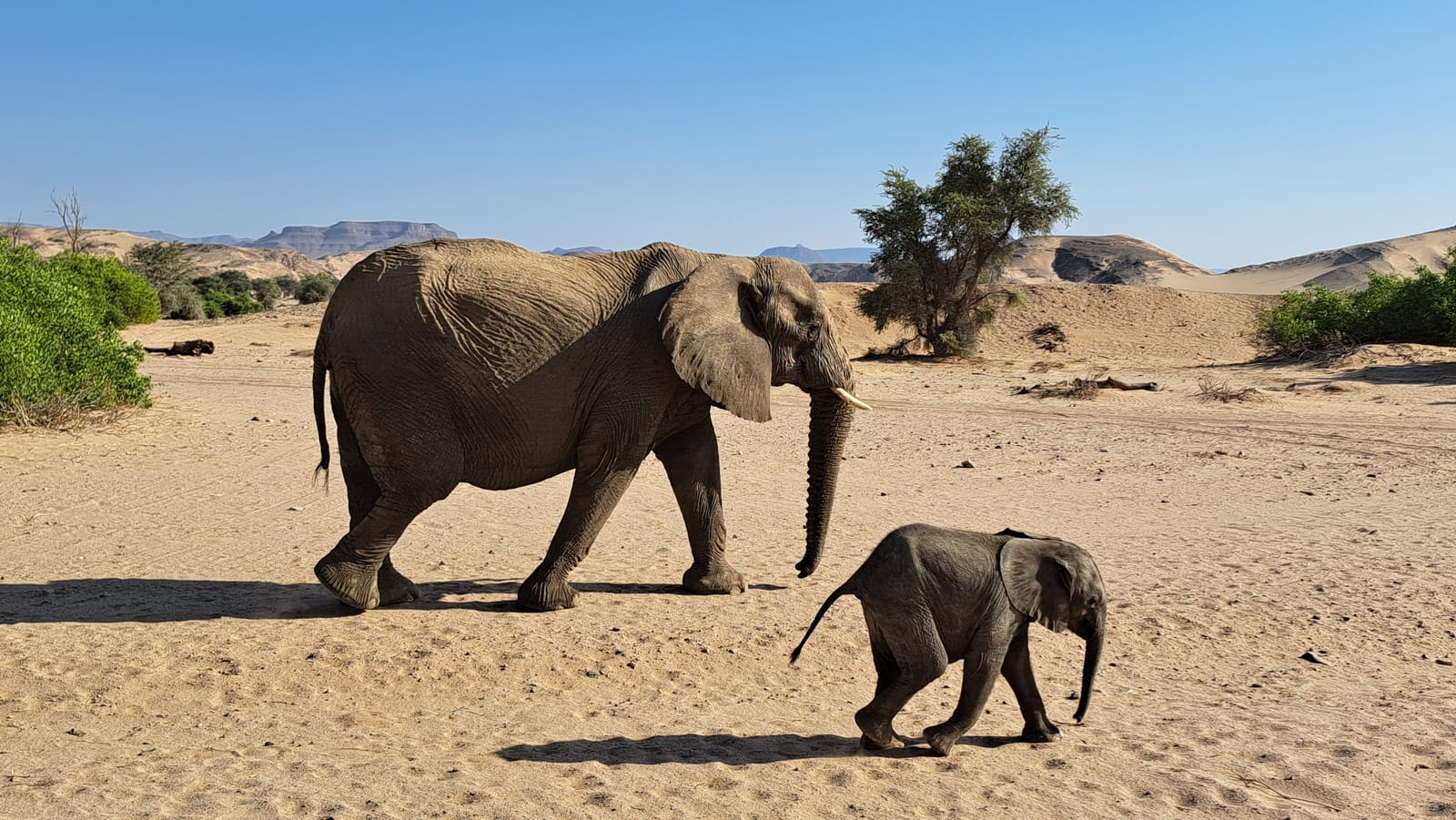
The morning began with a desert elephant safari, and it came with a complication nothing in the brochures mentions: too many vehicles, too close to the animals — more touristic resource than wildlife protection. The surroundings, at least, were astonishing regardless of the crowding: dry riverbeds threading through pale, eroded hills, the kind of landscape that makes it obvious why these elephants have had to adapt the way they have.
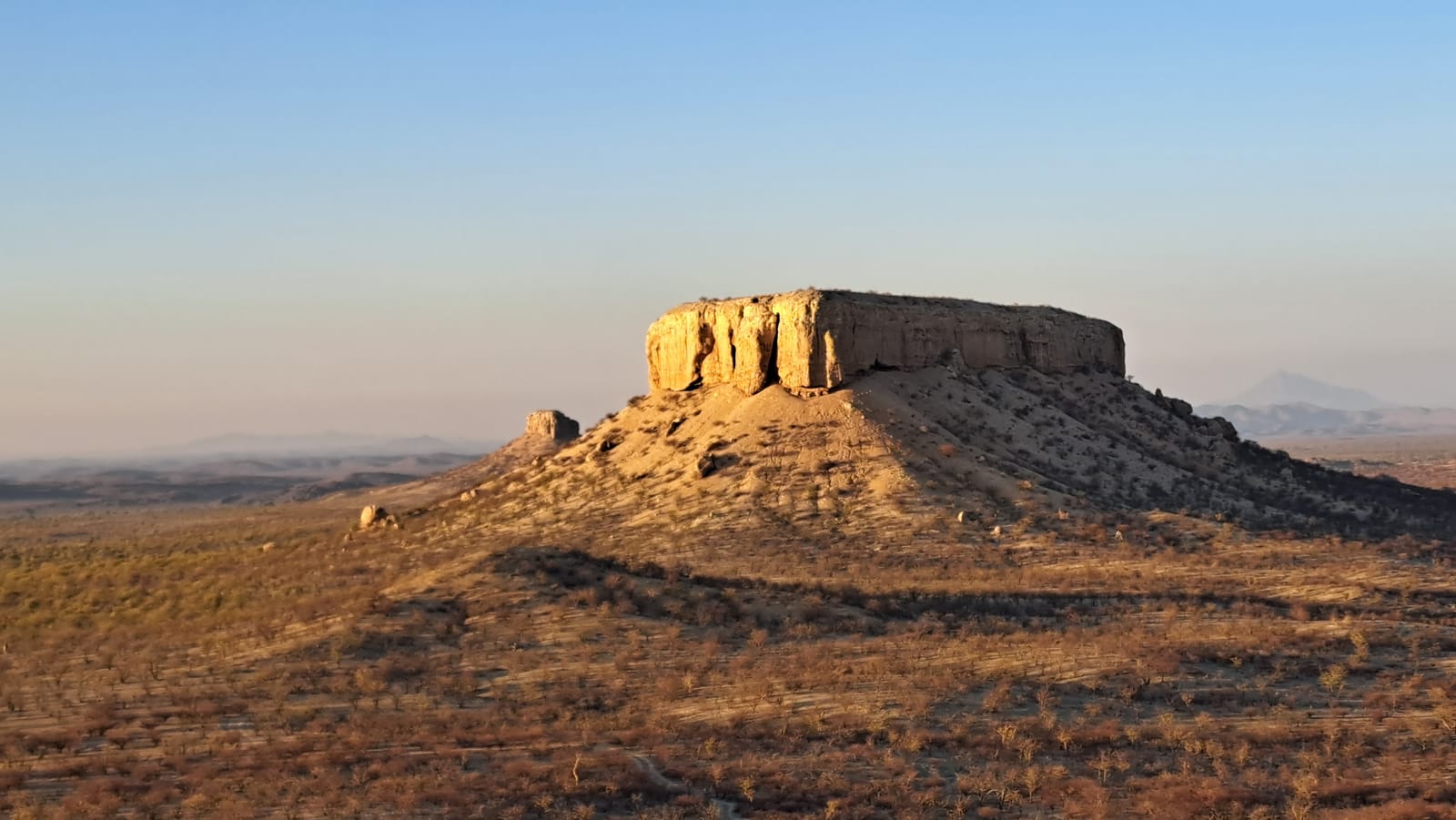
In the afternoon, back on the road to Vingerklip. If the drive to Etosha had been shorter, this stop might have been skipped — it isn't strictly necessary. But we were glad we didn't skip it. The formation itself, a limestone pillar standing alone above the plain, is striking enough on its own. What stayed with us more was the surrounding terrain: a few beautiful mesas rising out of an otherwise infinite plain.
Etosha National Park — Days 11–13
The last morning at Vingerklip began before dawn. We climbed the rock above the lodge in the dark and waited. The plain below emerged slowly out of the night, the mesas catching the first light before anything else. It was worth every minute of sleep lost.
Etosha announced itself with crowds at the gate — a sharp return to the logic of a major park after the quiet of the preceding days. It did not last. Once inside, the scale of the place absorbs everything: an immense, almost flat plain, bone-white in the midday light, with the salt pan at its center and mopane woodland stretching in every direction.
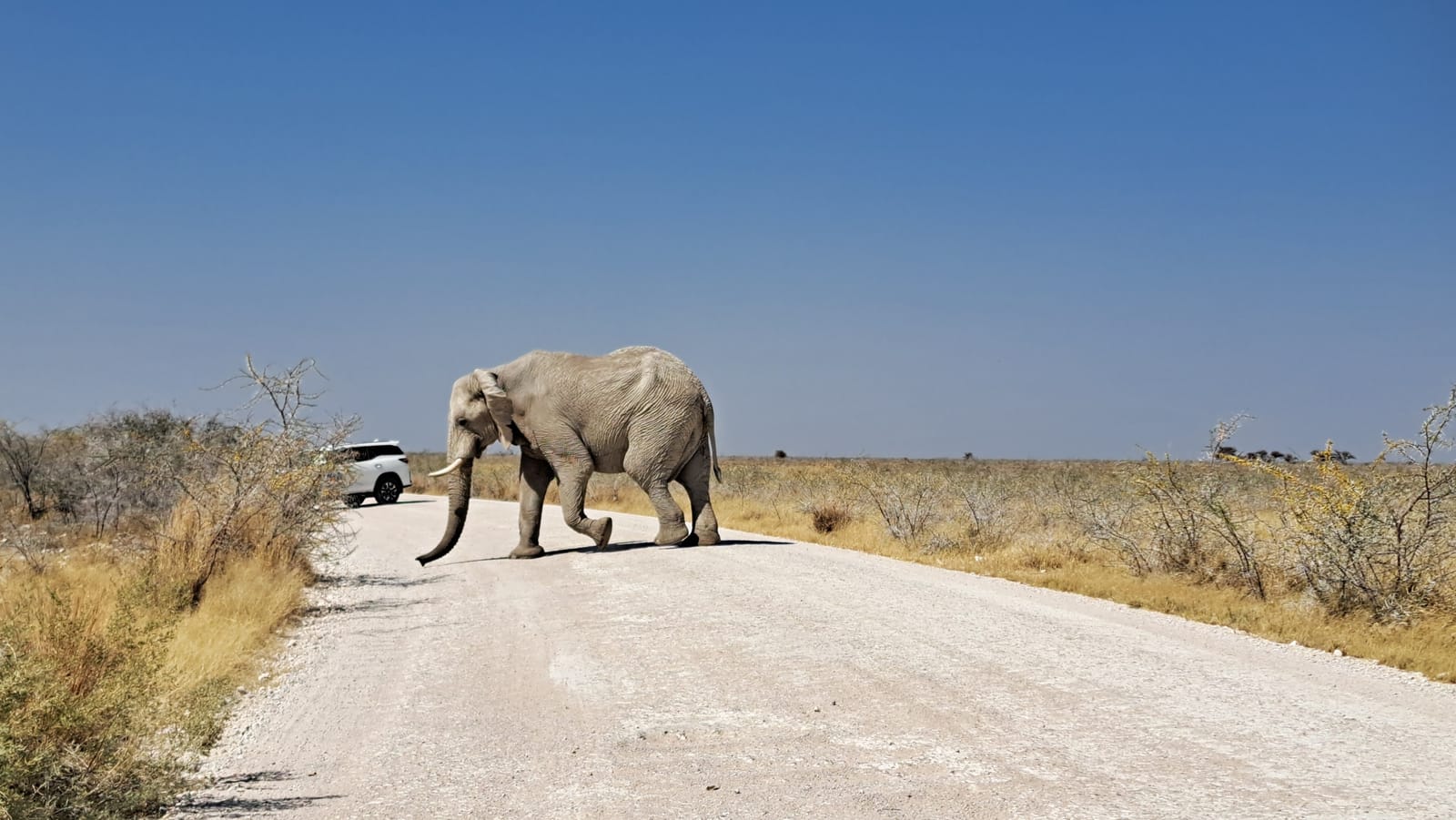
The first encounter set the tone immediately. A gray dot far out on the plain resolved, as we drove closer, into an enormous bull elephant — which then crossed the road directly in front of us, unhurried, indifferent to the car, occupying the full width of the track before disappearing into the bush on the other side.
What had been occasional, surprising encounters on the road north — a giraffe here, an oryx there — became, inside Etosha, simply the background. Herbivores everywhere, in numbers that quickly recalibrate what you consider worth stopping for. The focus shifted almost immediately to carnivores.
Exploring Etosha revolves around the waterholes. Some are natural, some artificial; the natural ones, fed by underground springs at the pan's edge, draw the widest variety and produce the most unpredictable encounters. The days developed their own rhythm: drive the tracks, stop at every waterhole, read the stillness or the movement of the animals gathered there, wait.
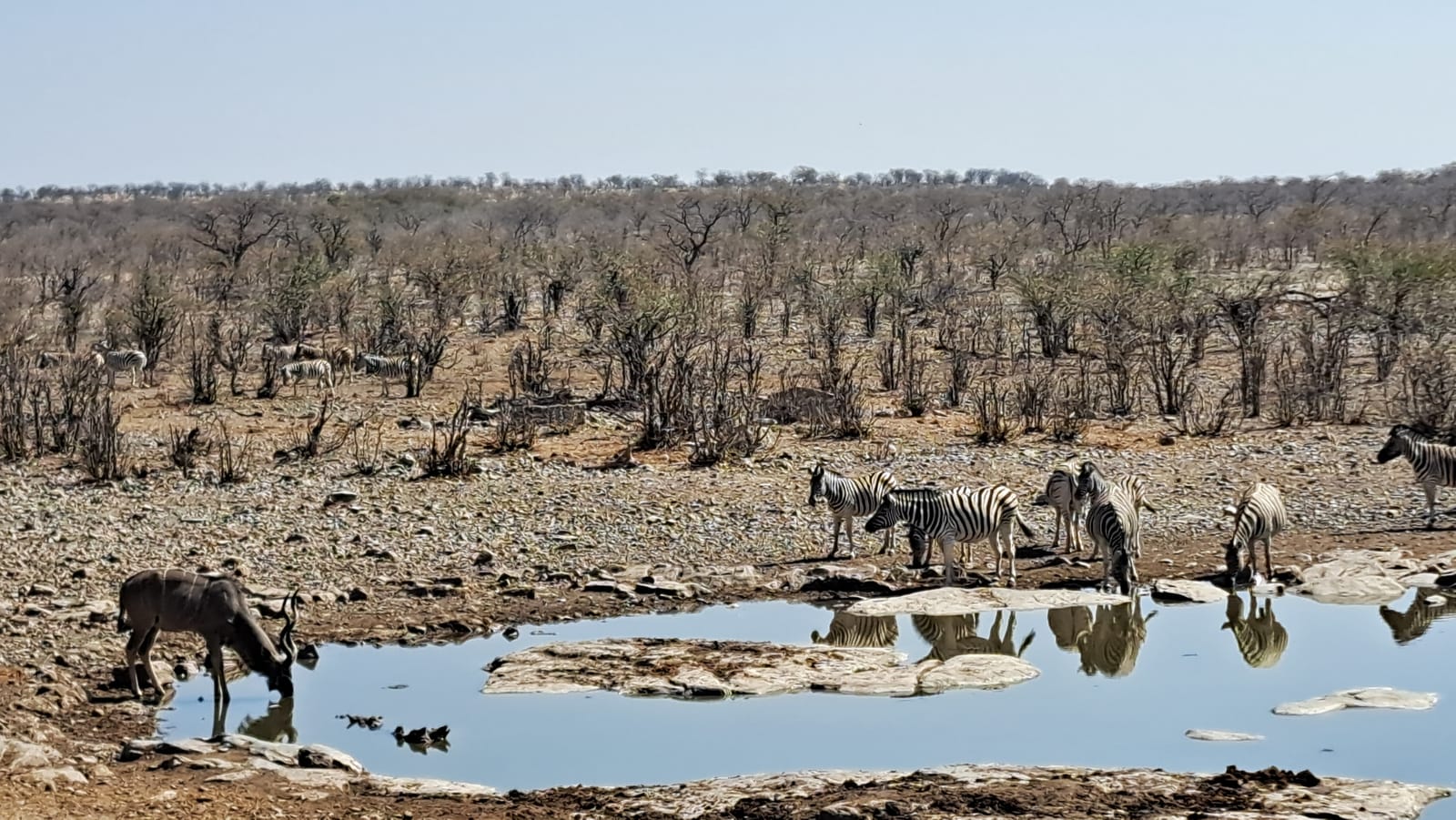
A useful rule emerged quickly: whenever you see a cluster of parked vehicles ahead, slow down. Something is always there.
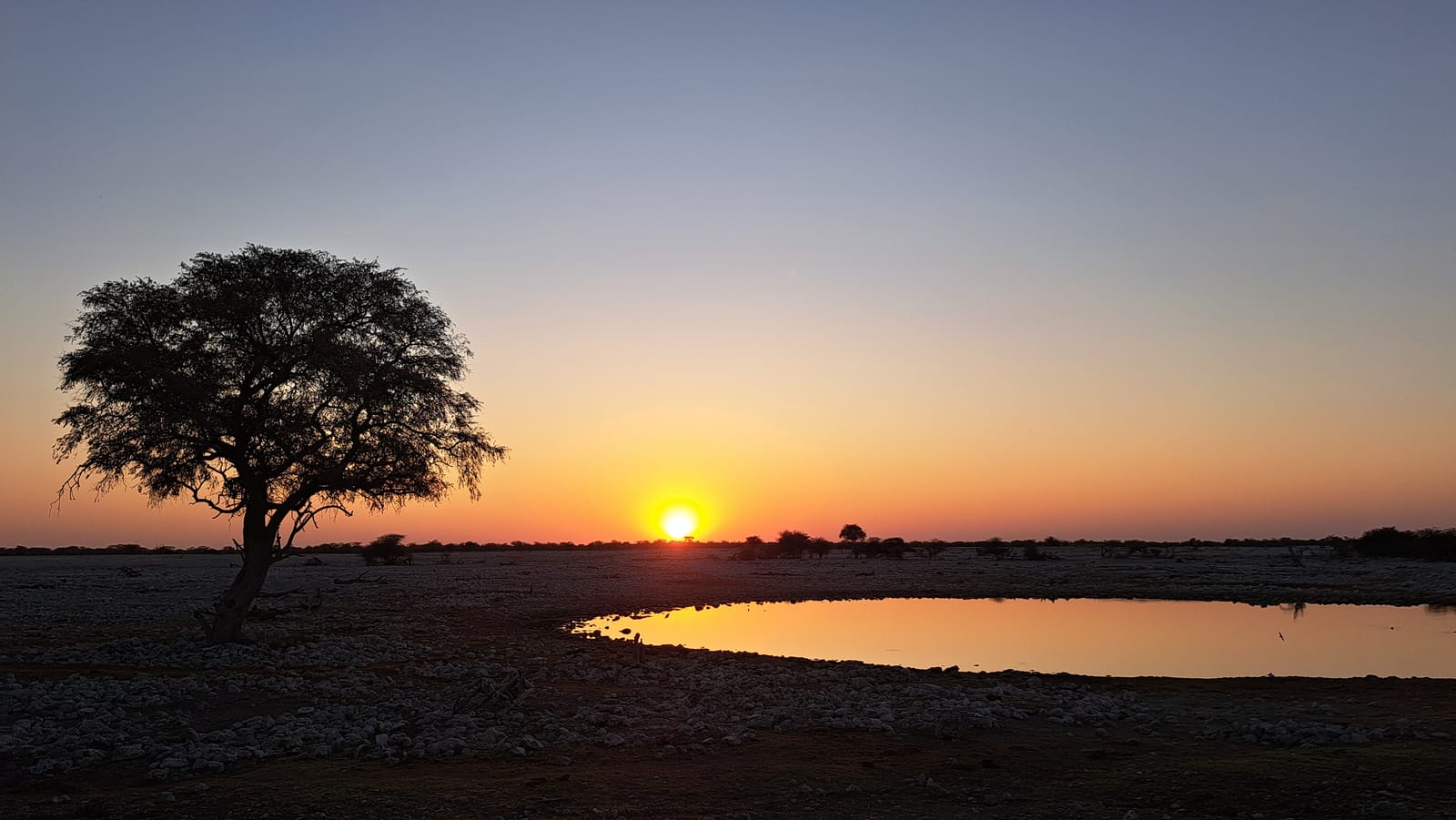
We stayed in two camps over three days, each with its own floodlit waterhole visible from the perimeter. At dusk, and through the night, the animals came — the waterhole becoming a small theater of necessity, lit against the dark.
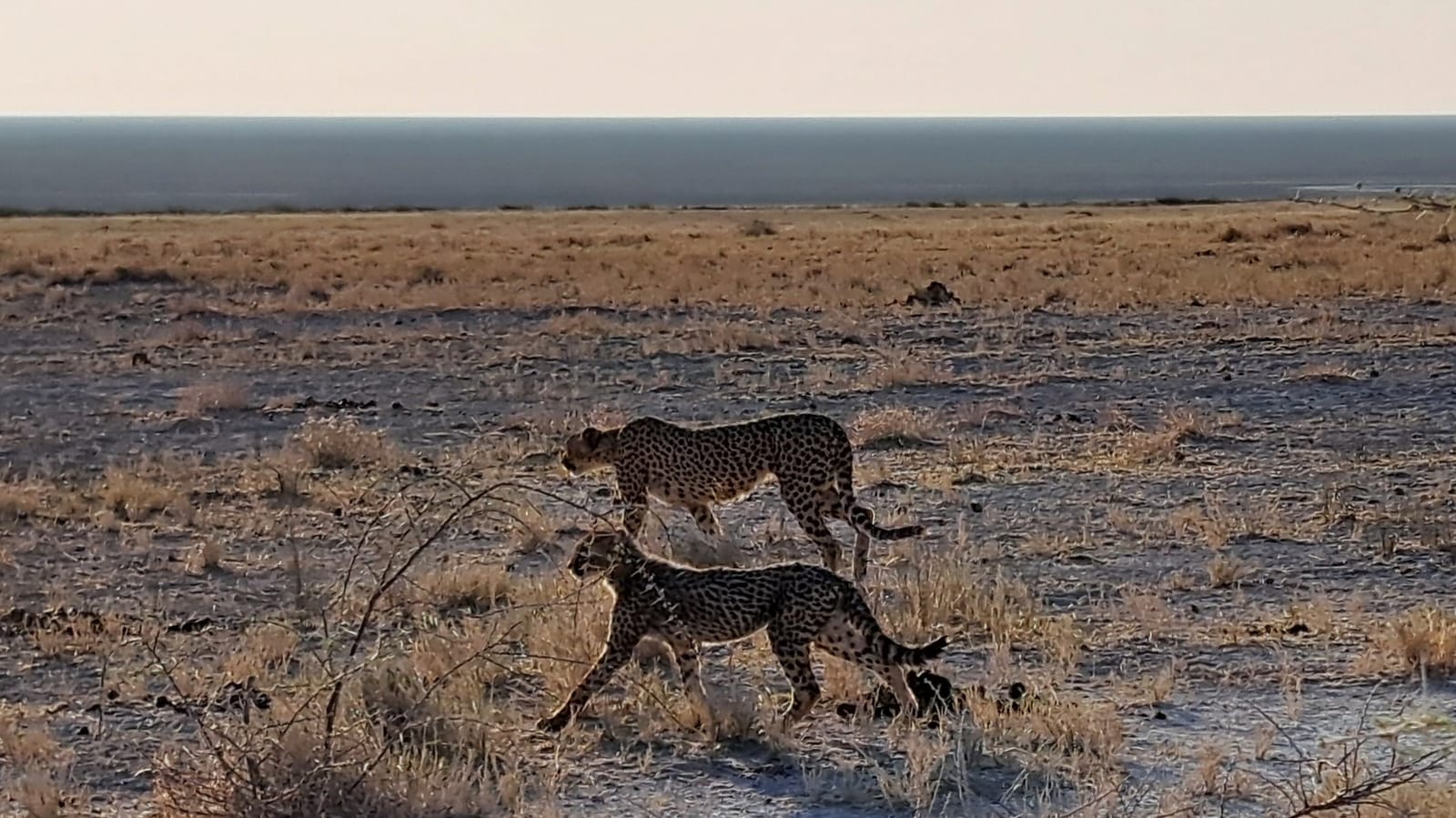
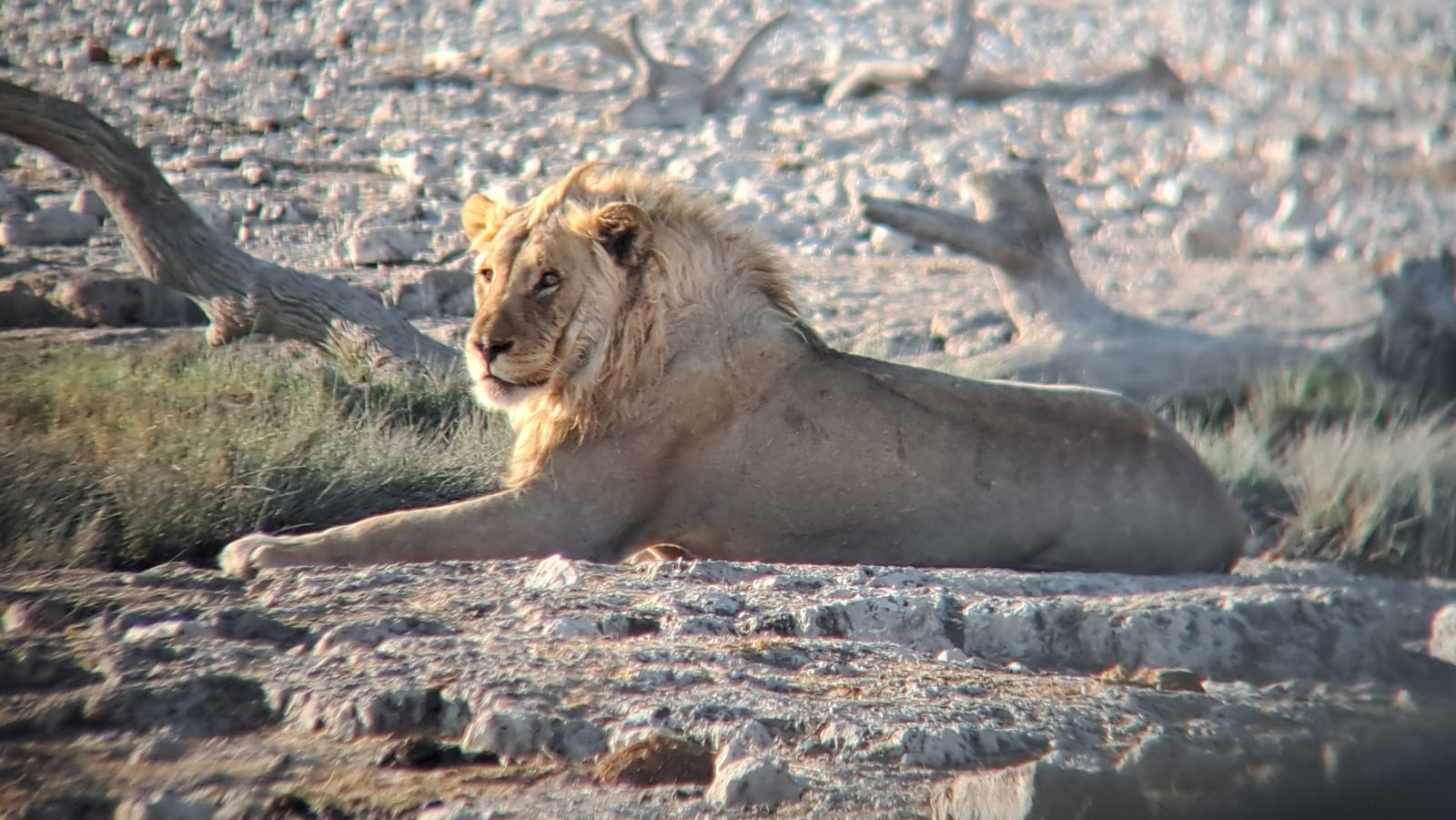
The first day produced a lion, resting near a waterhole with the complete indifference of an animal that has nothing to prove. It set the bar high — perhaps too high. The second day was hours of driving, waterhole to waterhole, no cats, growing quiet in the car as the afternoon went on. Then, close to the gate curfew and almost out of hope, first hyenas and then two cheetahs appeared at the edge of the plain, moving with the quick, taut grace that distinguishes them from every other animal. The day recovered entirely in the last twenty minutes.
The third day brought more lions — several sightings, unhurried, magnificent.
Unfortunately, we never saw a leopard. We looked far and wide, but nothing. We will have to come back.
Waterberg Plateau — Day 14
The drive to Waterberg is the last long leg of the trip — a gentle descent from the intensity of Etosha into something quieter and more contained. The plateau itself rises abruptly from the surrounding plain, a flat-topped sandstone mesa that turns deep red in the evening light, and the lodge sits at its base.
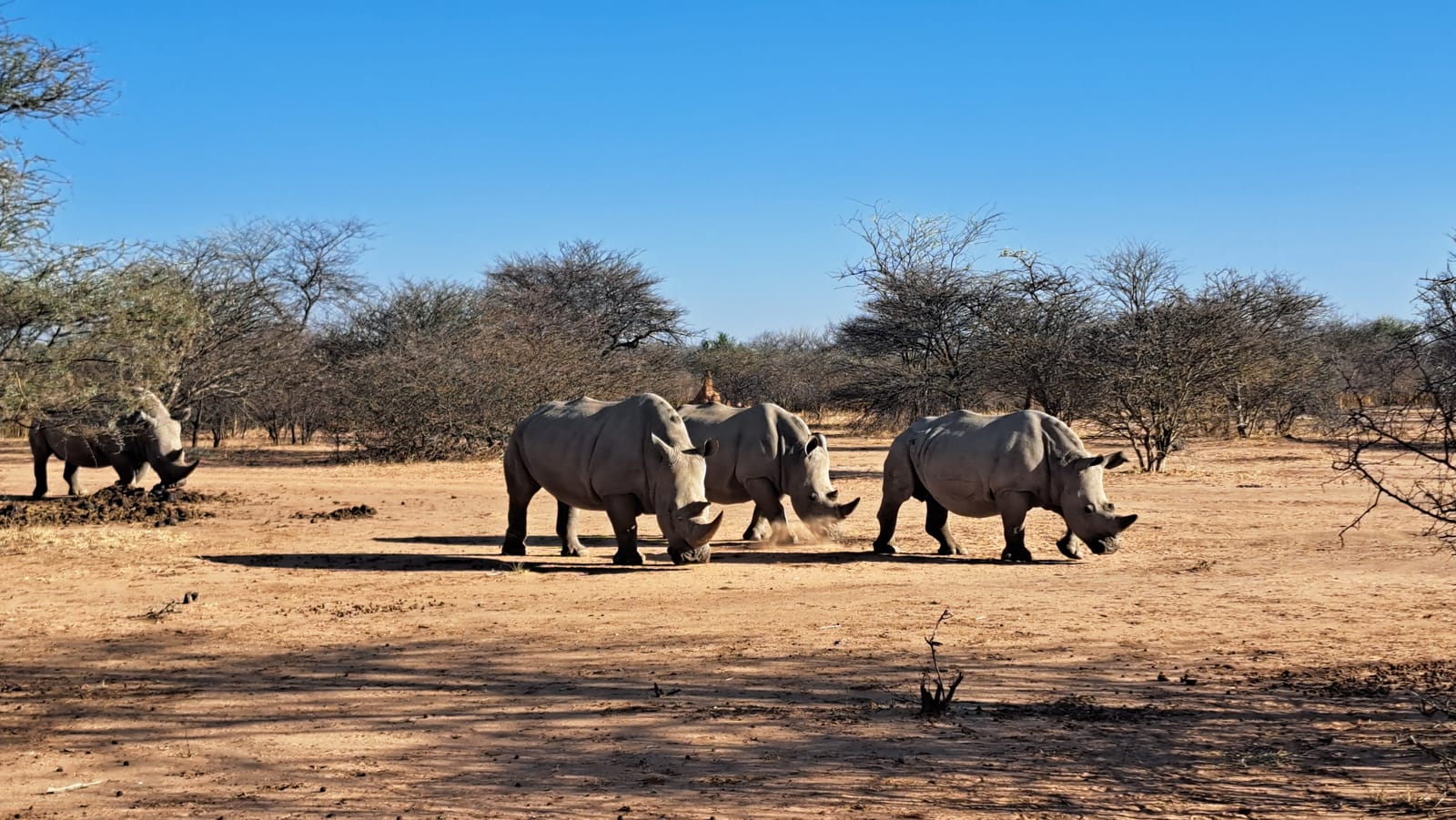
We arrived in time for the afternoon guided excursion into the reserve. Waterberg operates as a sanctuary within a sanctuary: a protected enclosure holding a small number of white rhinoceros, guarded around the clock by armed patrols. The rhinos are there because they cannot safely be anywhere else — poaching pressure across southern Africa has made unprotected populations functionally impossible to sustain.
The visit was strange. The animals were there, real and close, moving through genuine bush. And yet the armed guards, the controlled perimeter, the sense of a managed presence rather than a wild one left an ambivalence that stayed with us. The rhinos did not seem to care. Perhaps that is what really matters.
What had been occasional, surprising encounters on the road north became, inside Etosha, simply the background.
The trip was drawing to its end. The last drive back to Windhoek was melancholic in the way that only a return journey can be — the same road, the same landscape, but everything now behind you rather than ahead. The heart, though, was full.
In Windhoek, one last stop before the flight: a famous beerhouse, cold lager and a hamburger in the middle of southern Africa. One final contradiction from such a beautiful country. Then the airport, the plane, and home.