Norway was our way of getting back to travel after the years of pandemic confinement and after quieter vacations with young kids. At the time our daughters were five and nine, and for what we considered their first real trip, we chose to stay in Europe without giving up the outdoors we love. After months spent imagining fjords and high plateaus, we set off knowing the weather would be a wild card, and that rain, in these parts, is almost a certainty rather than a risk.
The route
- 1 Bergen
- 2 Aurland
- 3 Otternes Bygdetun
- 4 Flåm
- 5 Gudvangen
- 6 Kjelfossen
- 7 Aurlandsfjellet (Snøvegen)
- 8 Olden
- 9 Briksdalsbreen
- 10 Kjenndalsbreen
- 11 Loen
- 12 Breng Seter / Lovatnet
- 13 Geiranger
- 14 Trollstigen
- 15 Bispevatnet
- 16 Dovrefjell (muskox safari)
- 17 Grimsdalen
- 18 Jotunheimen (east)
- 19 Gjende
- 20 Glitreberget (Hotel California)
- 21 Geilo
- 22 Vøringsfossen
- 23 Eidfjord
- 24 Granvin
- 25 Bergen (Fløyen, Bryggen)
- 26 Oslo
Day by day
Day 1 — Arrival and the storm
We landed in Bergen in the late morning, and the city welcomed us with a sky already low and gray. We picked up the car at the airport and set off again almost immediately: no stop in the city, that would come only at the end of the trip. Our direction was northeast, toward Aurland, along the E16.
We were already on the road when the phone made a sound we had never heard before. It wasn't a ringtone we recognized, and we hadn't set it ourselves: it was a government alert message, in Norwegian, that took over the phone and for a few moments wouldn't let us do anything else. With the help of a second phone we managed to translate it, and discovered we were in the middle of a weather alert. Along the road to Aurland the notifications repeated several times, and our worry grew along with the rain, which kept getting heavier.
We arrived at our destination in the late afternoon. Between the rain, the alert, and the low clouds covering the mountains, we had no desire to go out and see anything, even though in Norway, in August, it doesn't get dark until well past ten in the evening. We stayed indoors, and watching the news we found out we had landed right in the middle of one of the most intense rainstorms ever recorded in Norway.
We went to sleep a little worried: our cabin stood right beneath a steep mountain, and we fell asleep with an unspoken thought, that something could happen to us too.
Day 2 — Otternes, Flåm, Gudvangen, and Kjelfossen
We woke up under a gray sky with rain still pouring down. We didn't let it discourage us and set off anyway to see the surrounding area.
Our first stop was Otternes Bygdetun, a hamlet of log houses, interesting as a historic village, though desolately empty.
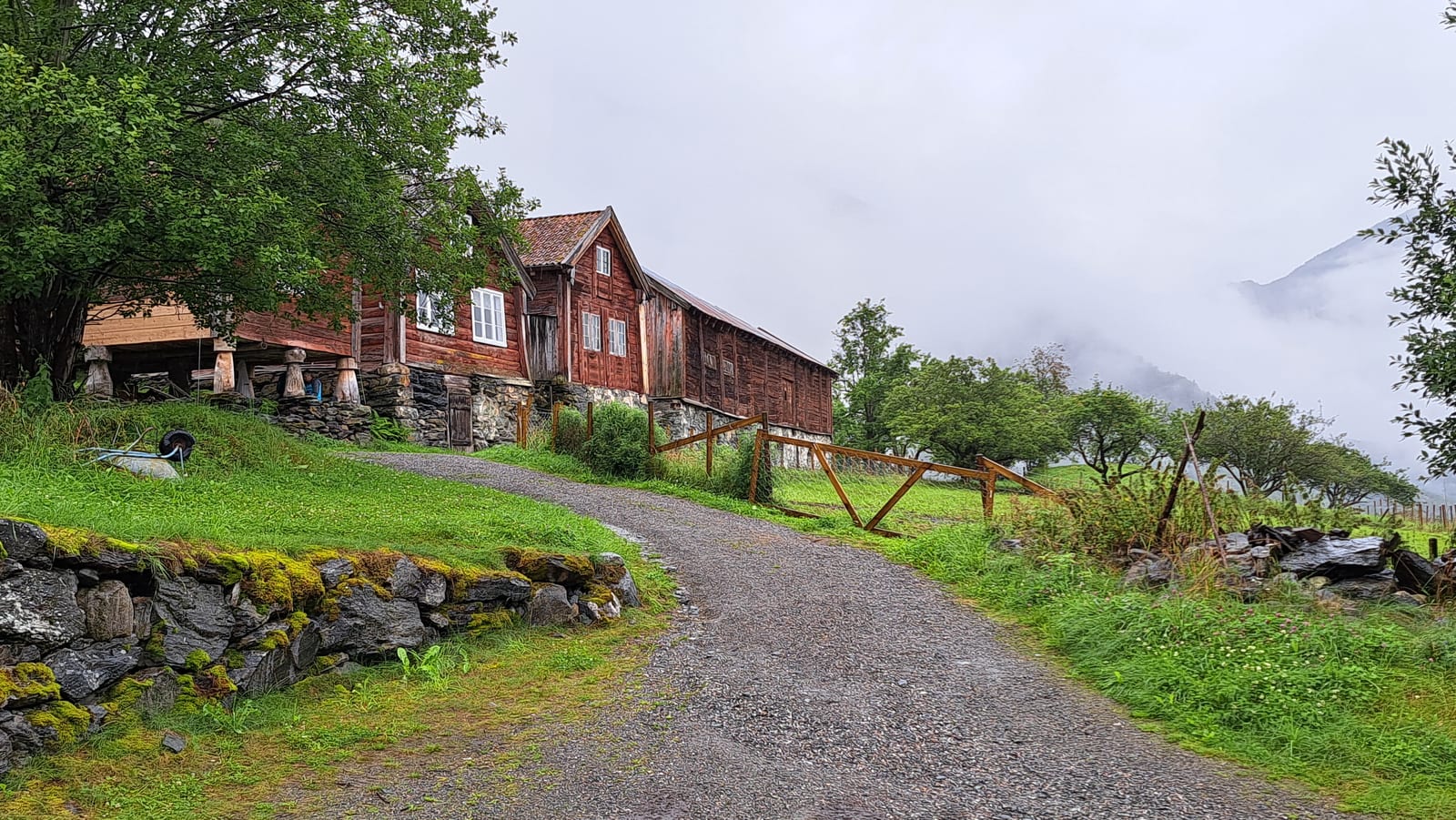
Afterward we moved on toward Flåm hoping to catch the Flåmsbana, the famous mountain railway connecting Flåm to Myrdal, but unfortunately we found it closed, like most Norwegian railways because of the weather conditions. We had to make do with a look around the museum and the souvenir shops.
In the afternoon we moved on to Gudvangen, where a reconstructed Viking village stands that we wanted to show our daughters to keep them entertained for a bit. The village isn't really much to speak of, but it's just enough to amuse a five- and a nine-year-old.
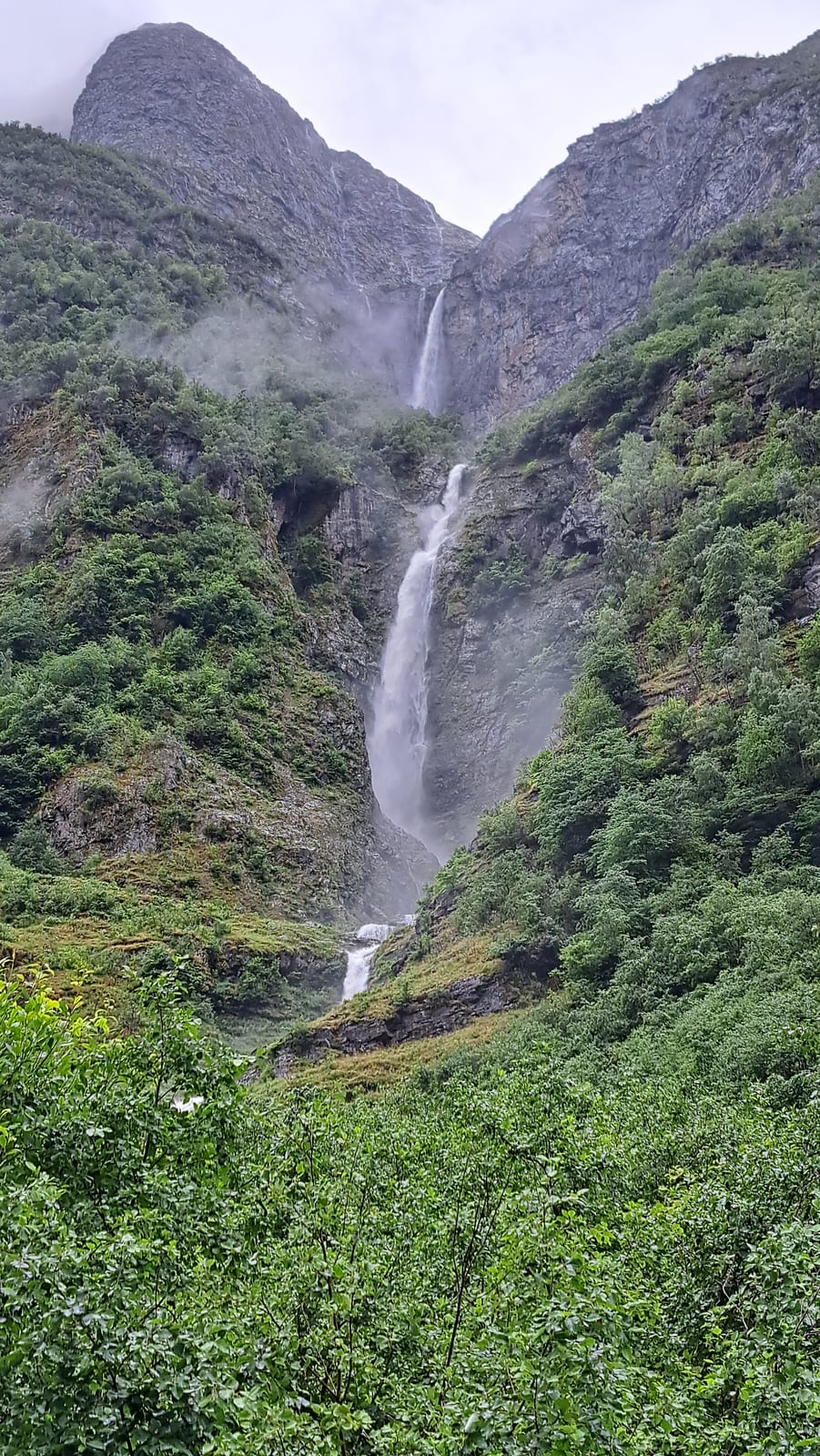
We closed the day at the Kjelfossen waterfall, spectacular, even more so with its flow swollen by the relentless rain of the past few days.
That evening we went back to sleep at the same place as the night before.
Day 3 — The Snow Road and on to Olden
The day began under a gray sky once again, but fortunately it wasn't raining. We set off toward the north.
We took the Aurlandsfjellet, also known as Snøvegen, the snow road, and climbed switchback after switchback up to the summit. A truly spectacular place, made of small lakes and snowfields still there in August.
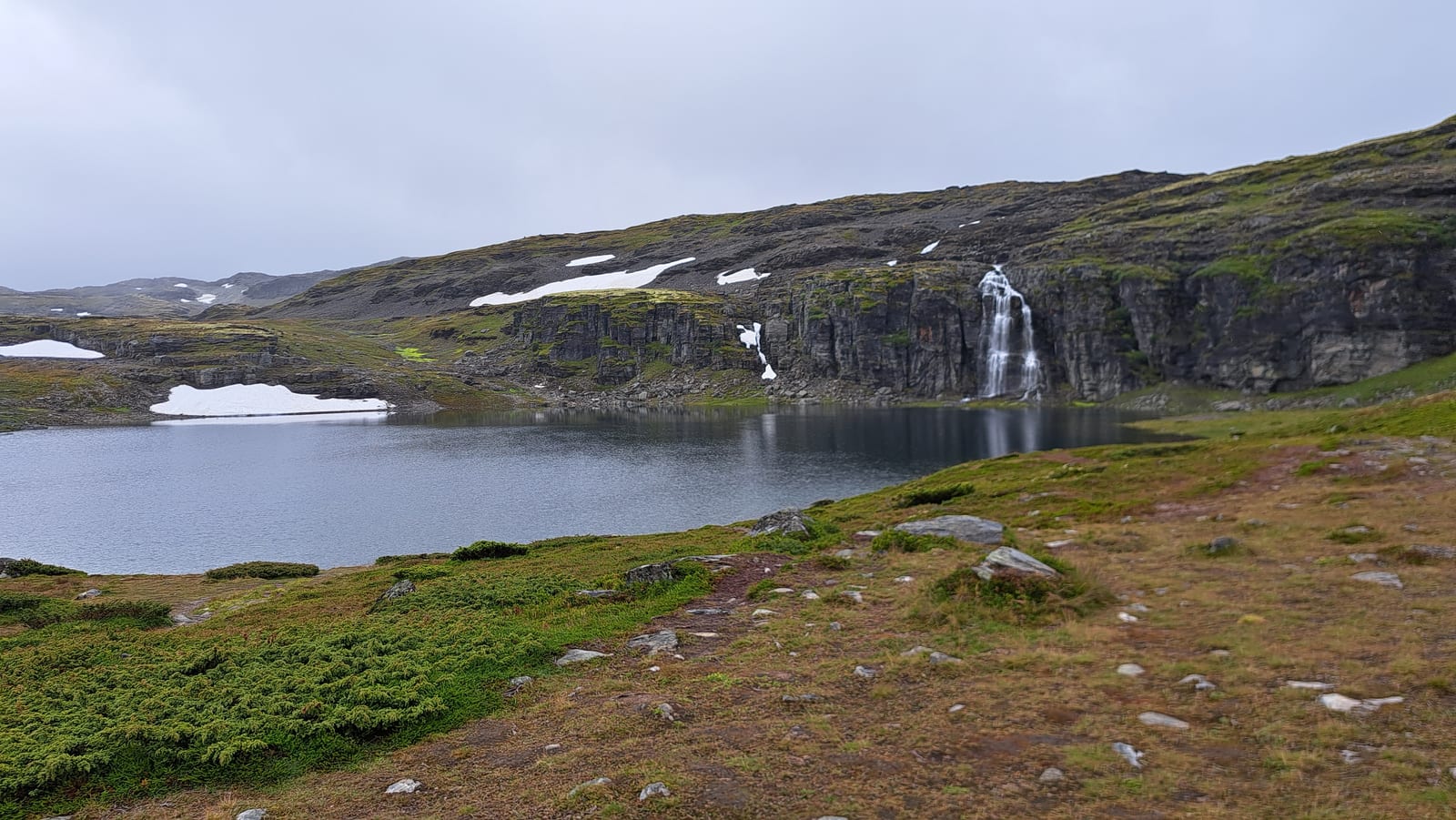
Unfortunately, just past the summit, we found a sign indicating the road was closed a little further down, so we had to turn around and drive all the way back down to take the tedious tunnel that leads north.
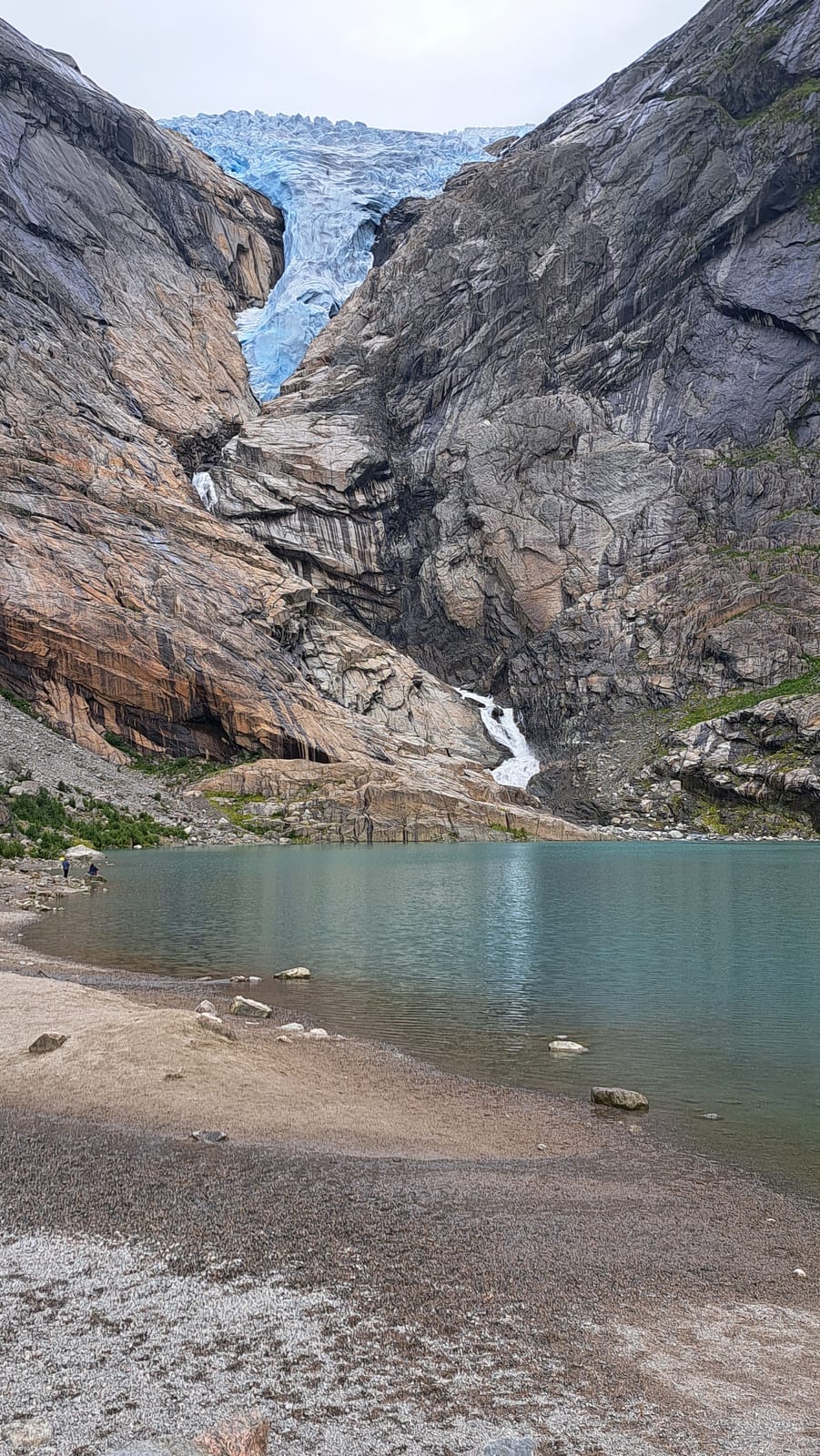
With patience, a little on edge over the lost time and the fact that the road closure wasn't already signposted at the entrance to the scenic route, we reached Fodnes to cross the Sognefjord by ferry and continue on toward Olden, at the mouth of the Oldedalen, the valley that leads up to the Briksdalsbreen glacier, in Jostedalsbreen National Park, named after the largest ice cap in mainland Europe, whose tongues until a few decades ago reached almost down to the valley floor. Global warming shows here too, and unfortunately the glacier's front has retreated a great deal. We arrived in the late afternoon, with the weather having worsened again.
Day 4 — Tvinnefossen and the Briksdalsbreen glacier
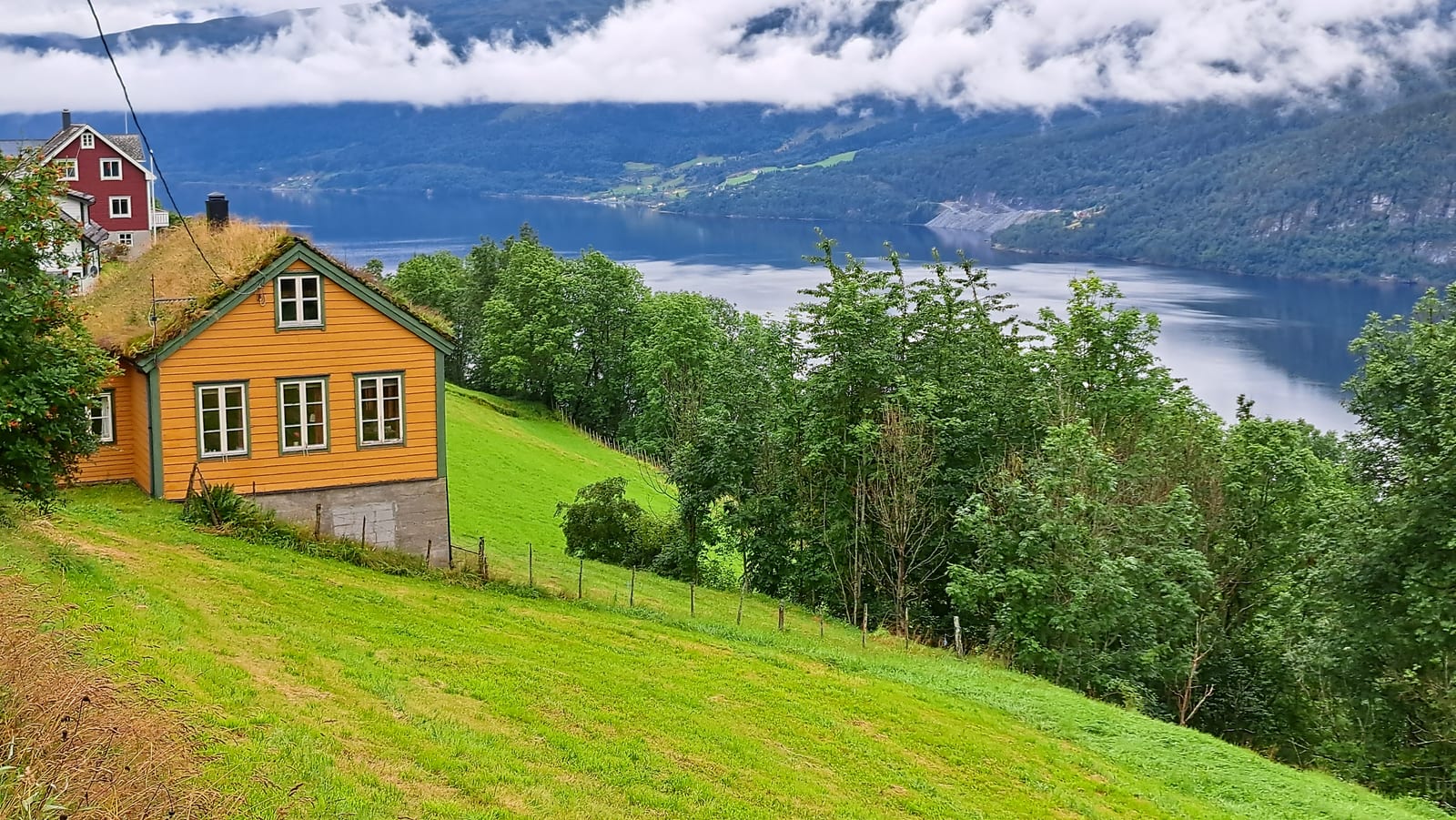
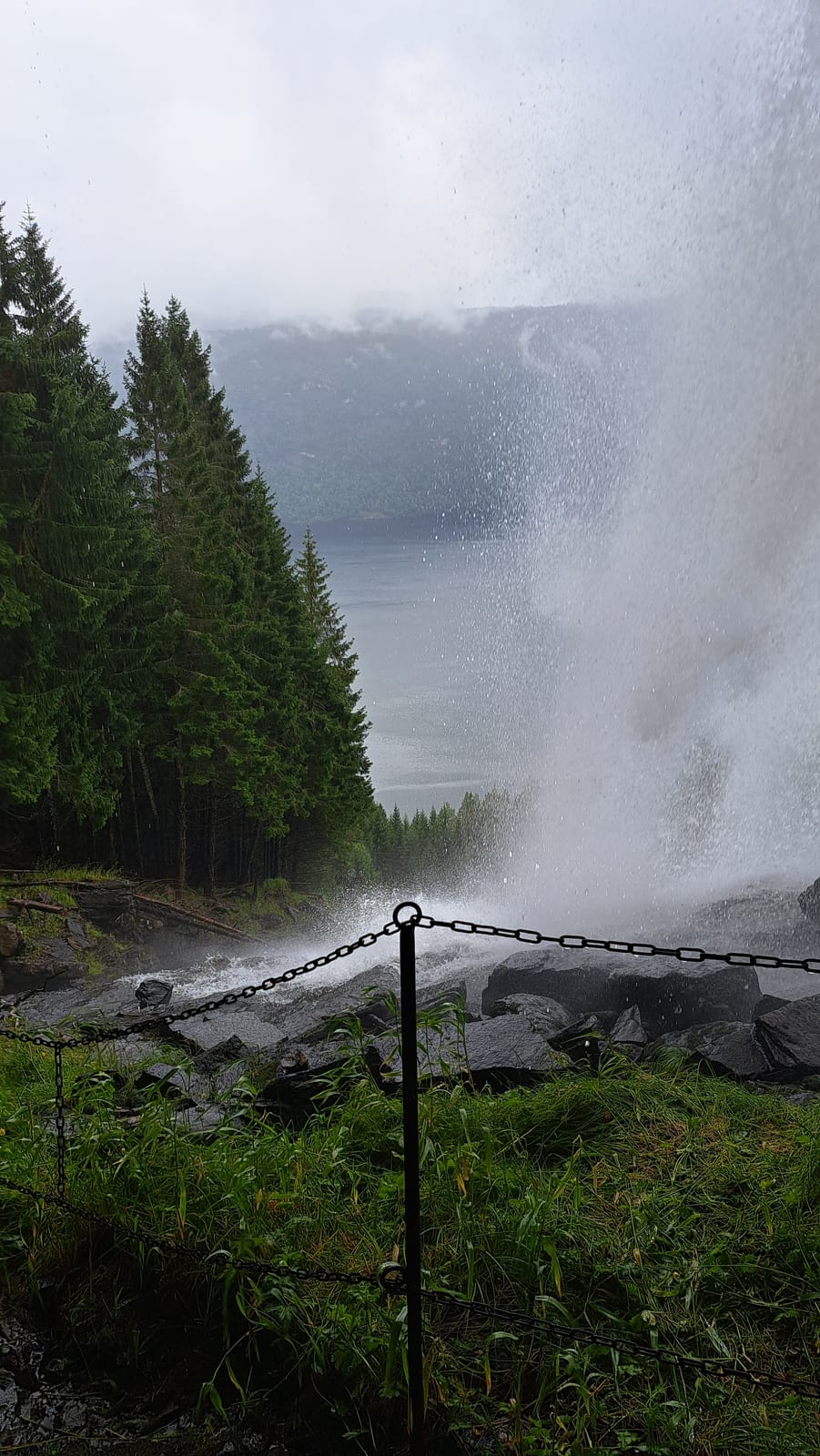
In the morning the sky was still gray, but it wasn't raining. We took the chance to go for a walk to the Tvinnefossen waterfall, or rather behind the waterfall: the special feature of this spot is being able to walk through a cavity behind the flow of water. Lovely, and the trail to get there is lovely too, with pretty houses above the fjord.
Then we went back to Olden to visit the Briksdalsbreen glacier with the Kleivafossen waterfall and the glacial lake. The weather held, and we managed to make our visit almost dry. Impressive to see how much the glacier had retreated compared to the pictures in our guidebook.
Day 5 — Kjenndalsbreen, Lovatnet, and the Geirangerfjord
Finally the sun. It's incredible how after a few days of rain, just a little sunshine is enough to put you in a good mood when you wake up.
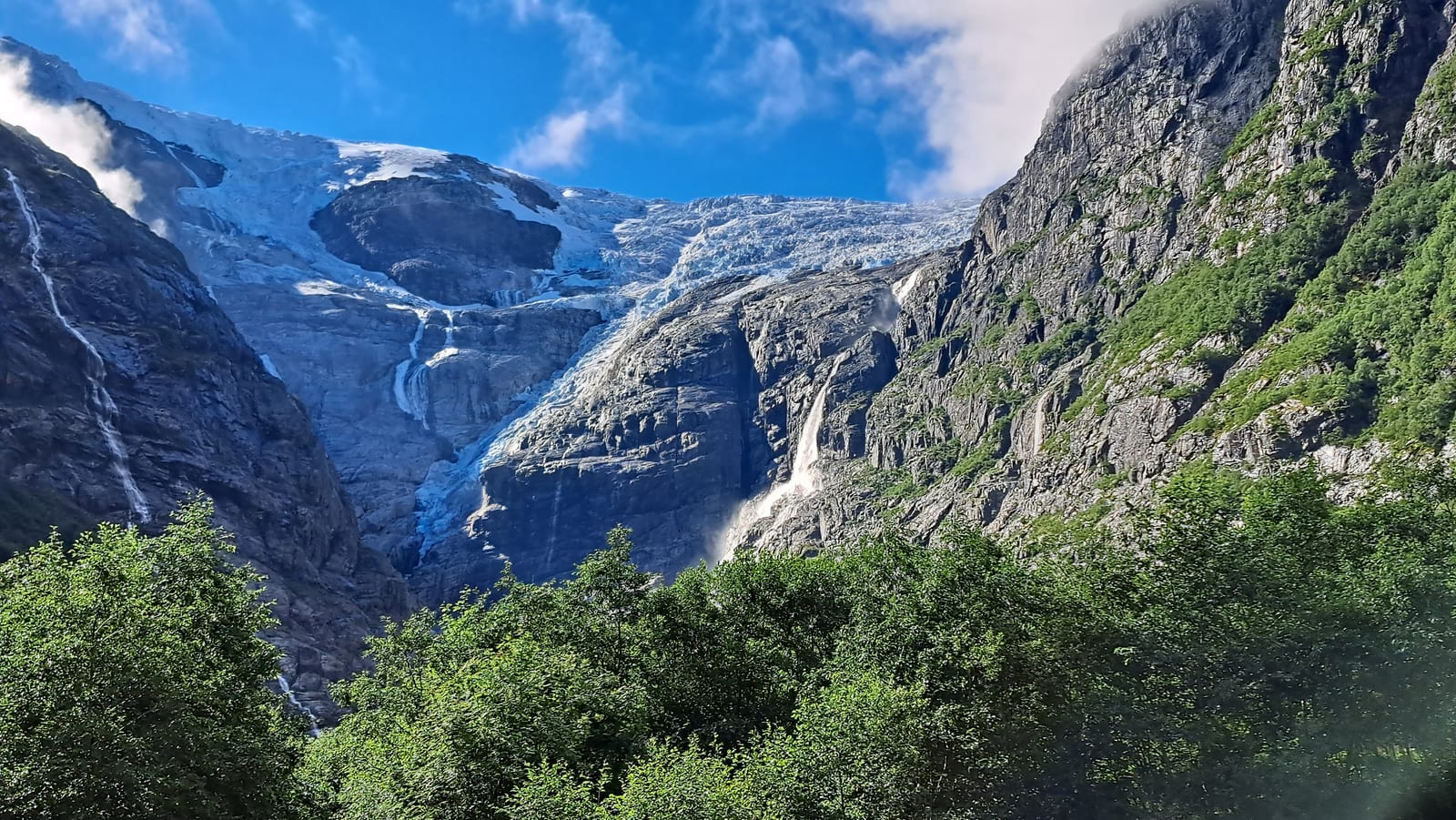
We packed our bags quickly and set off to visit the Kjenndalsbreen, another tongue of the Jostedalsbreen glacier. The glacier with a blue sky behind it is a completely different thing to photograph.
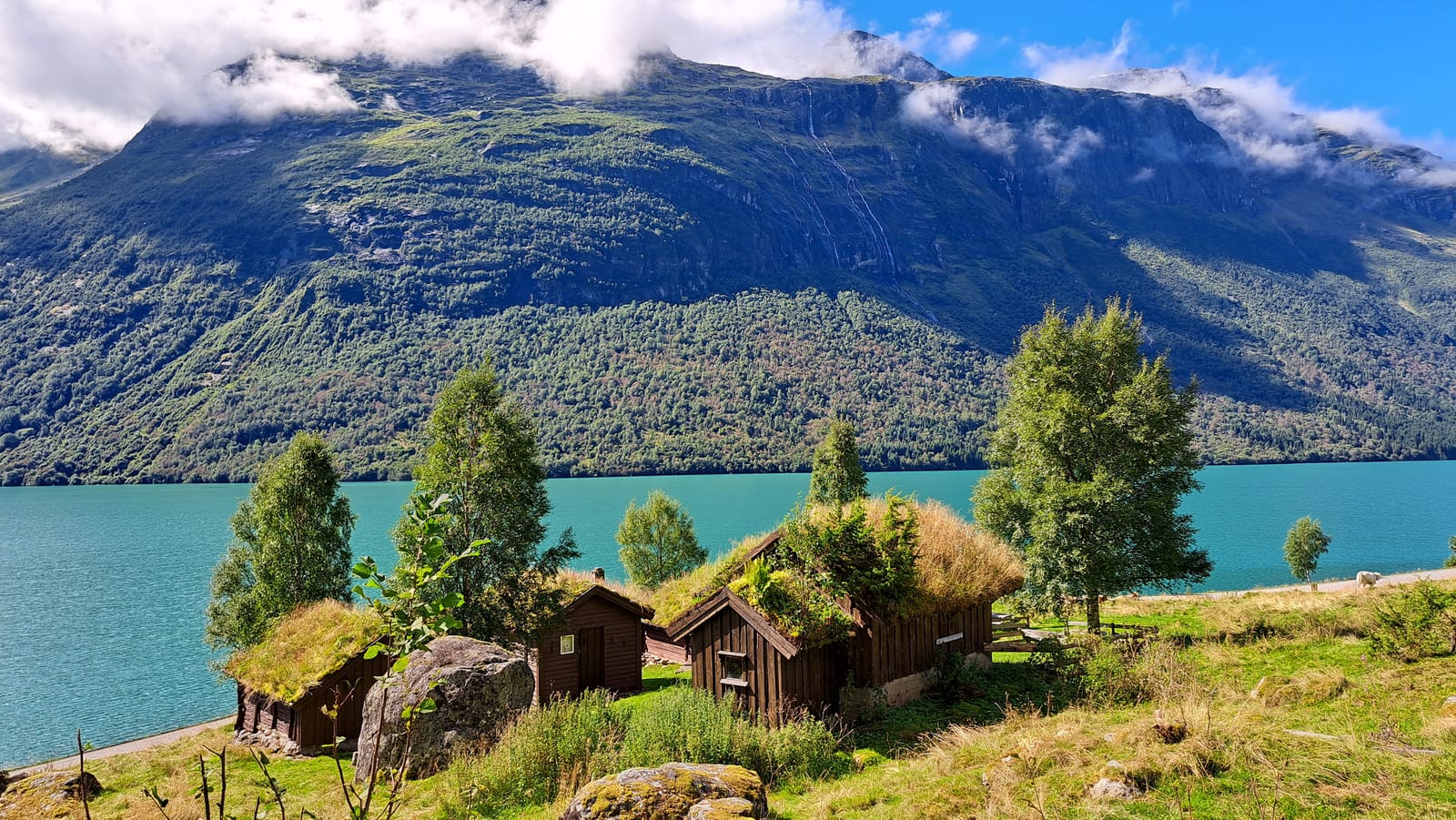
After the glacier, we took a short walk in Loen, the town at the mouth of the valley. Given the good weather, we pushed on to Breng Seter, a small cluster of turf-roofed wooden houses directly above Lovatnet, the beautiful turquoise lake fed by the glacier.
In the afternoon we got back in the car heading north, toward Hellesylt, where the ferry for Geiranger awaited us, along with our little cruise on the famous Geirangerfjord.
.jpg)
We had high expectations for this passage along the fjord. And it's undeniably beautiful, and yet, to some extent, it may sound absurd, it reminded us of parts of Lake Como: blue water, steep walls. The waterfalls and the farms clinging to the rock are, however, a feature unique to the fjord.
The arrival in Geiranger was rather startling, with our ferry, not even that small, still looking tiny next to the gigantic cruise ships moored at the head of the fjord.
The day had been very satisfying. We decided to close it out by making use of the hotel's heated outdoor pool, with a view of the fjord and the waterfalls, even though, unfortunately, in the meantime the sky had closed in again and rain was starting to fall.
Day 6 — Ørnesvingen, the Trollstigen, and Bispevatnet
Fortunately the rain from the night before had been only temporary. Waking up in Geiranger, too, we were greeted by a blue sky.
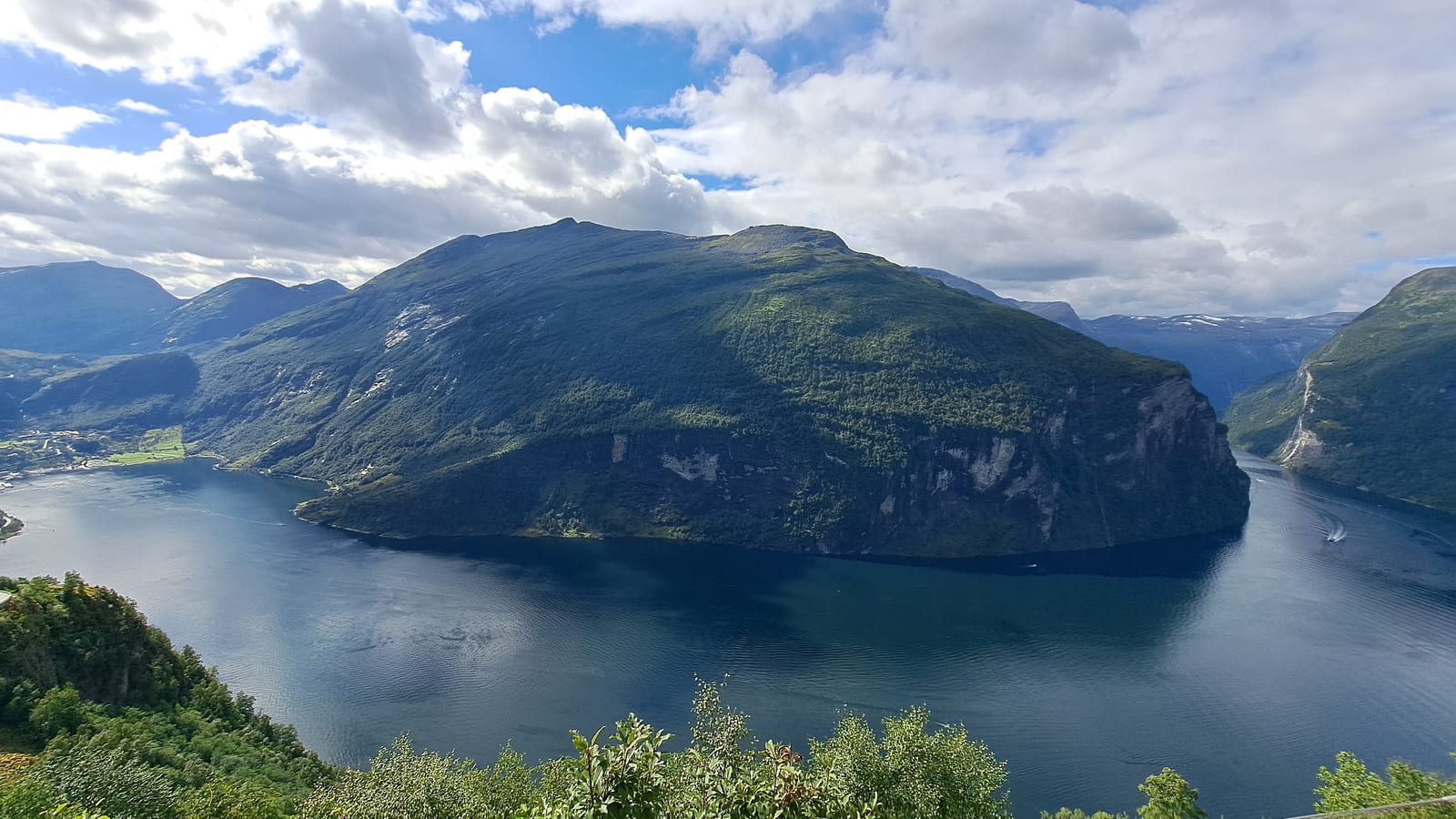
We took a short walk around the town, which is actually very small and visited in no time, not skipping the famous chocolate shop. Then we immediately got moving north, climbing the steep mountain behind Geiranger, making a first stop at Ørnesvingen, where a lookout point allows you to admire the whole Geirangerfjord from above.
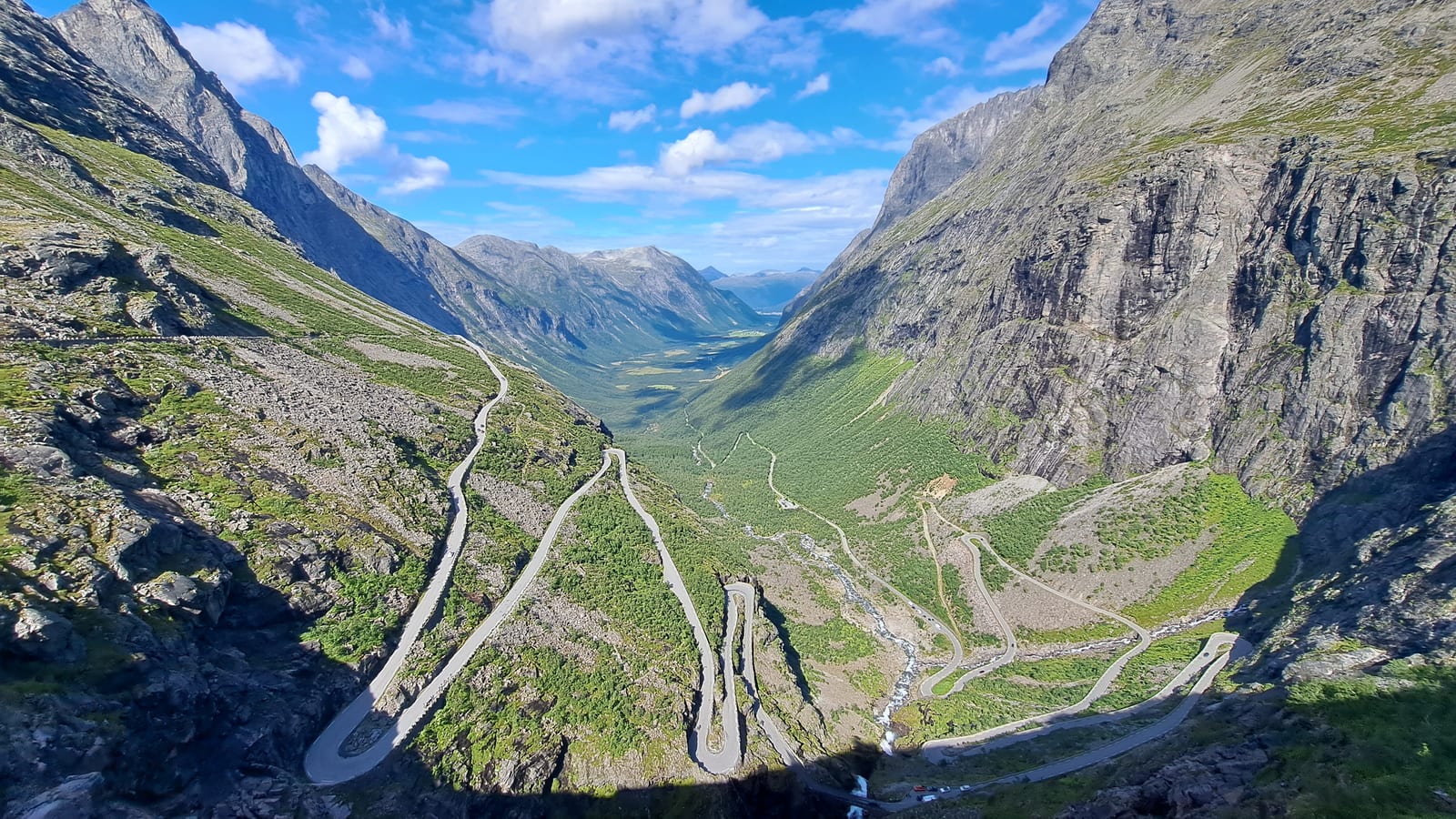
The highlight of the day was the Trollstigen, the famous switchback road, one of the most photographed in Norway, reached from the south by climbing up the Valldalen. The scenery is truly spectacular and it's worth the climb up here, especially when, as happened to us, after so many days of rain there is finally a bit of sun. During the climb, fields of cairns signal the approach to the highest point. At the top, wide lookout points fitted with iron walkways let you admire the Troll's Ladder in its full extent, with the whole valley stretching out toward Åndalsnes beyond it.
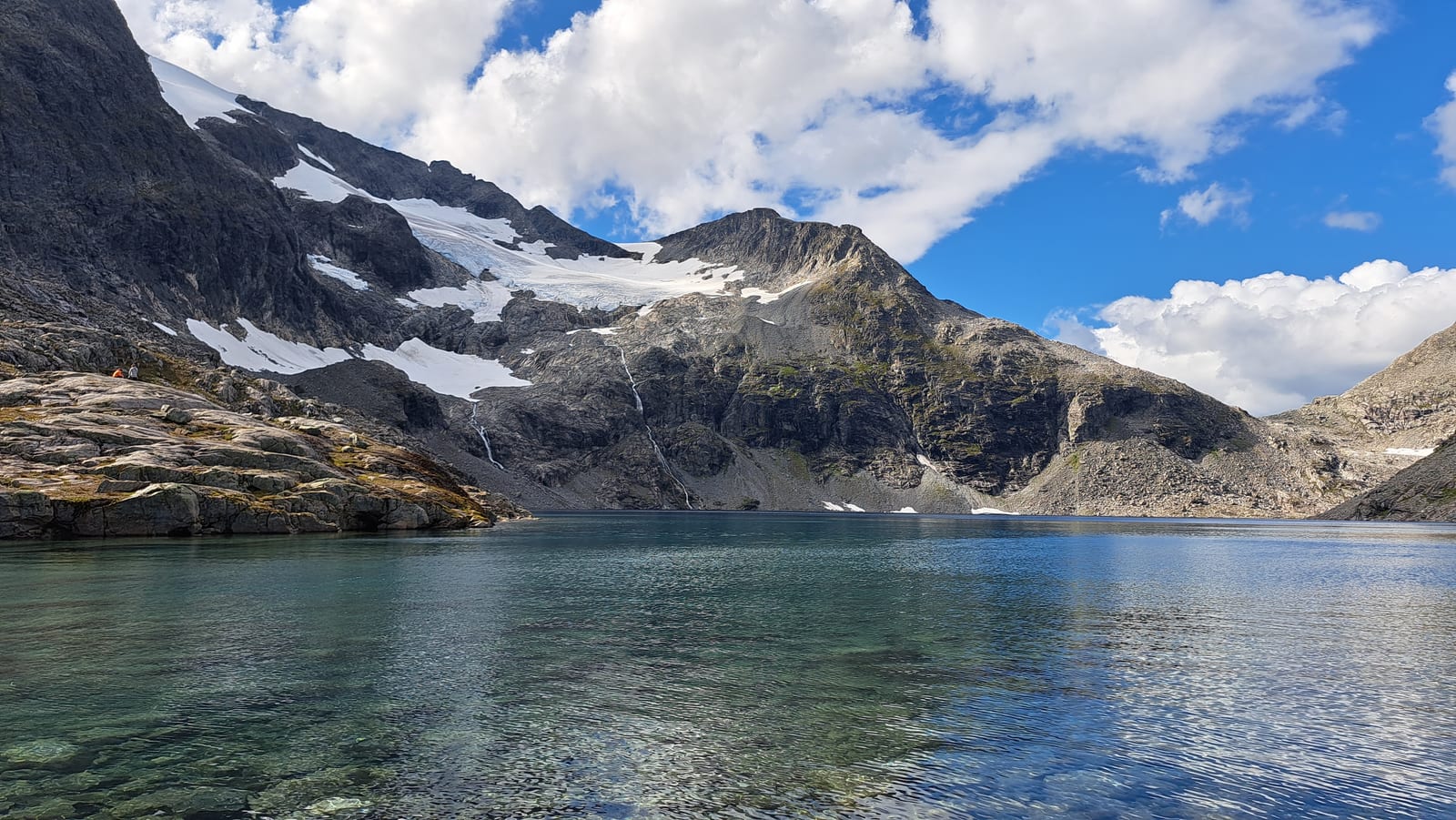
Before venturing into the switchbacks going down, given the good weather, we took the chance to do a short hike toward the Bispevatnet, a beautiful glacial lake, about an hour's walk from the top of the Trollstigen.
Once in Åndalsnes, we turned southeast to reach the Dovrefjell, a beautiful high plateau with a distinctly Nordic feel, with conifers in the lower part and fields of lichen as the altitude rises.
We arrived in Dombås, where we had booked a cabin for two nights, just in time to book the excursion, the muskox safari, for the following day.
Day 7 — The muskox safari in the Dovrefjell
The plan for the day was entirely devoted to the search for muskoxen, these Nordic animals that live in very few places in Europe, and the Dovrefjell is one of them. They aren't actually oxen at all, but goat-antelopes, related to goats and sheep, and large ones at that, with a thick coat that protects them from the cold of the winter months.
We met our guide in town, under a gray sky and low clouds, and with him we took the shuttle toward the refuge in the park, from where the excursions set off. Already from the little bus we spotted the first animals: in a way, we already felt satisfied.
Once at the refuge, other hikers joined us, and we set off for the safari on foot. The park is a huge, fairly flat expanse, covered in lichen and extremely rich in water. The trails are sometimes dirt tracks, sometimes faint traces through the vegetation.
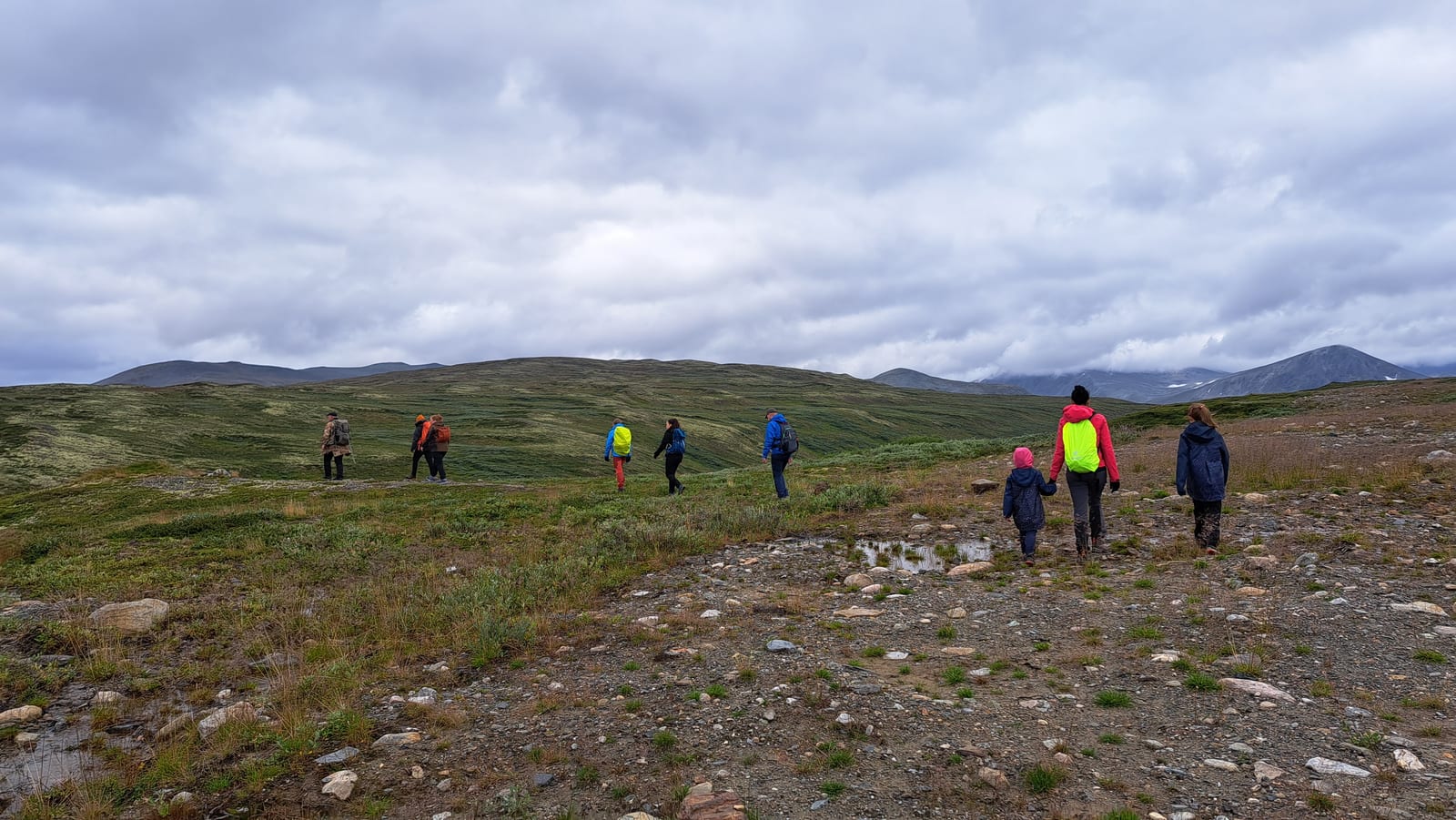
When we saw the first animals without the bus window between us, it was a real thrill. Cautiously, we got as close as we could without disturbing them.
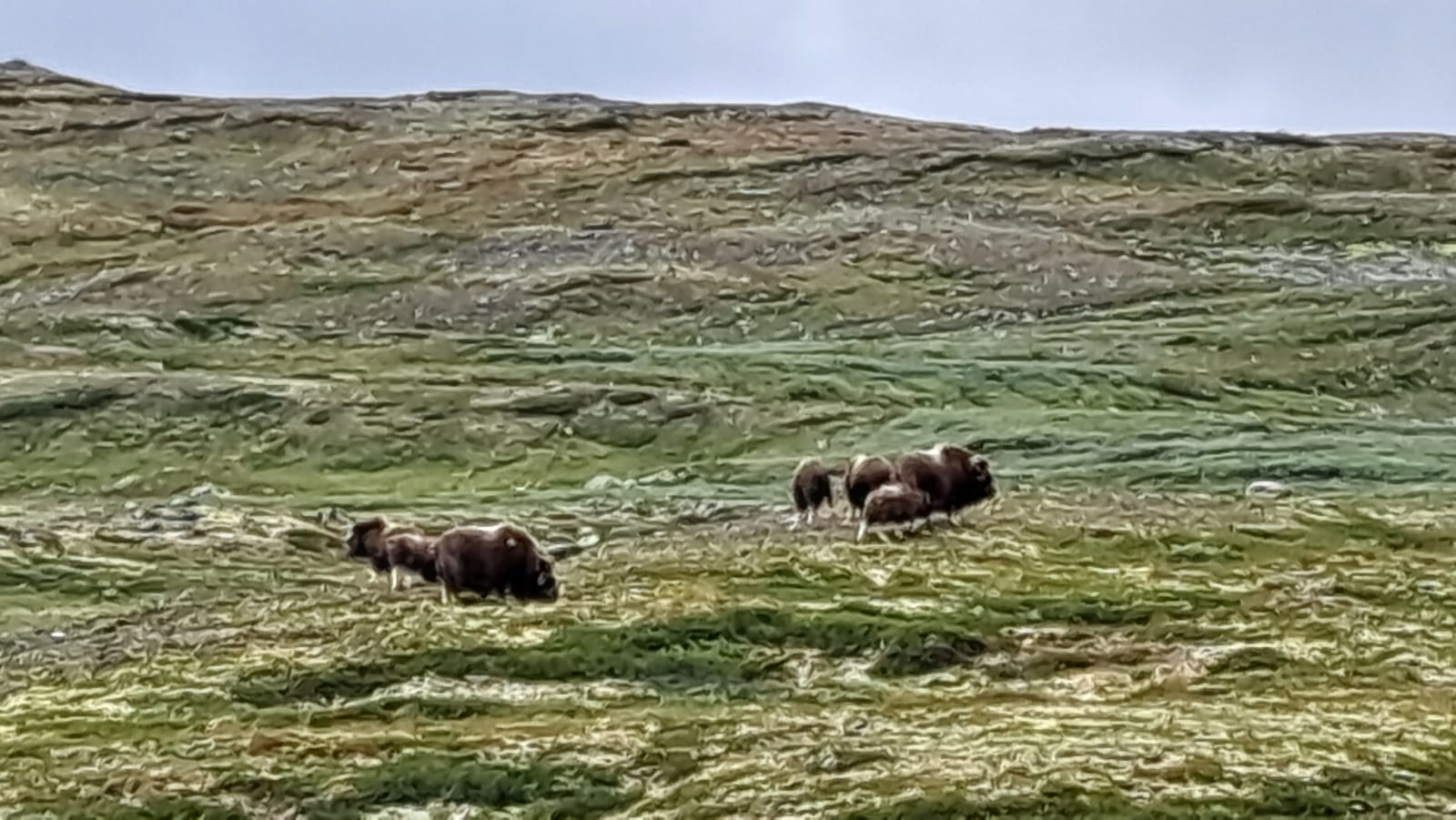
We wandered for hours and hours, covering more than fifteen kilometers, and we were also lucky enough to see, albeit at a great distance, our first reindeer.
The excursion itself isn't dangerous and doesn't require any particular skill. However, it isn't for everyone, because of the distances involved. We did it anyway with a five-year-old, though she was already well used to mountain trails, since we're keen hikers ourselves. Despite the gray sky and the fine, steady drizzle, it was perhaps the high point of the whole trip.
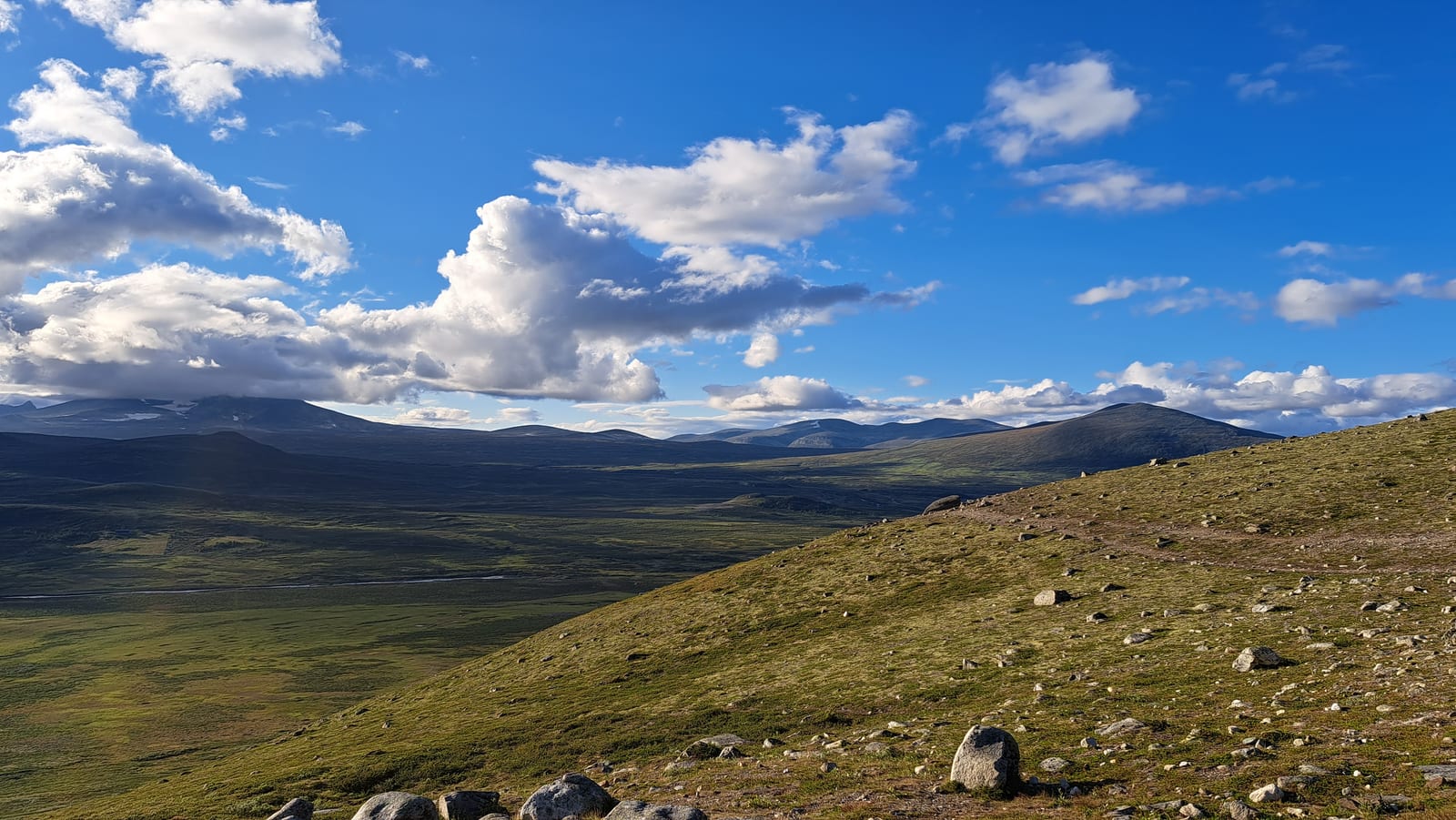
Once the excursion was over, a burst of clear sky seemed to open up, and before heading back to our cabin we took the chance to take another walk toward the Snøhetta Viewpoint, a beautiful lookout from which you can admire the immense plateau with the Snøhetta mountain in the background.
Day 8 — The Grimsdalen and on to the Jotunheimen
This day was set aside for moving on toward the Jotunheimen.
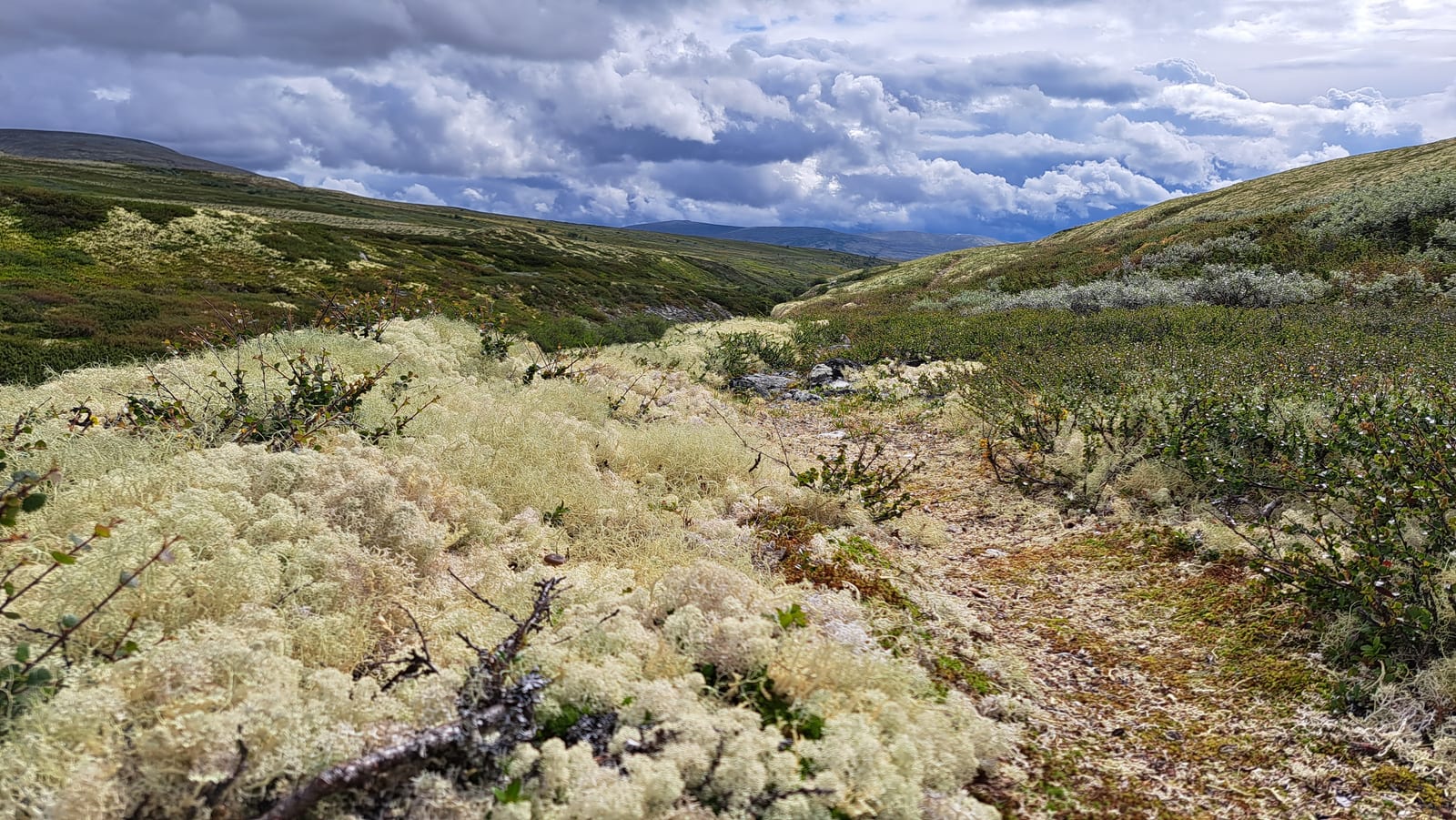
We woke up to sunshine, even knowing it wouldn't last long. So, along the way, we took the chance to do a hike in the Grimsdalen, a beautiful valley amid the lichen.
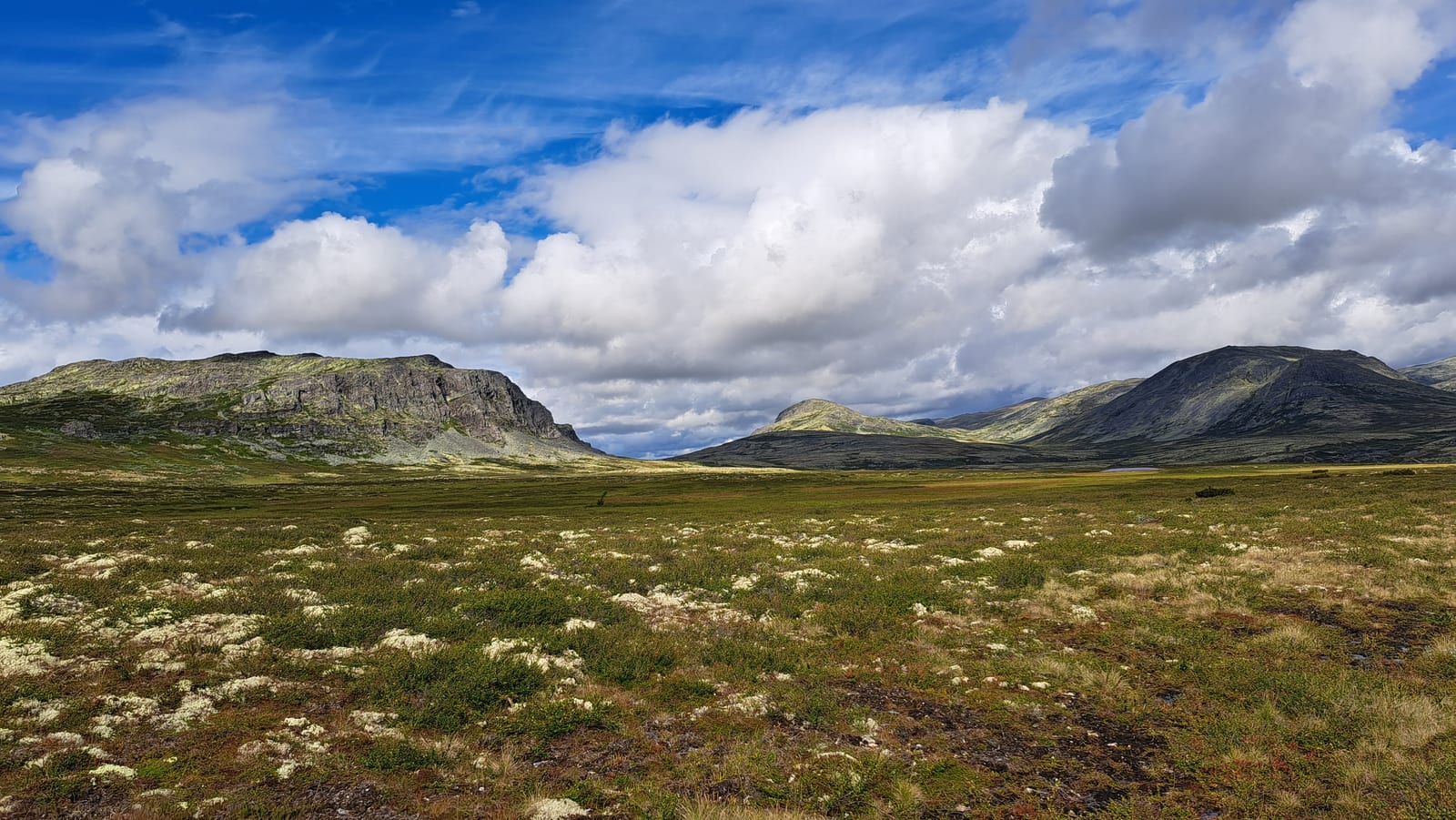
The goal was to reach the historic Grimsdalshytta lodge. We walked for a long time, but we had to give up on the banks of a stream, because the only bridge that allowed crossing it had collapsed due to the flooding. The flow of water was still too strong to think of fording it safely. A shame, we were a step away from our goal, with the binoculars we could clearly see the lodge, which, however, from what we understood, was closed.
A little disheartened, we retraced our steps, as the clouds gradually began to thicken in the sky.
We took the road south again, toward the eastern Jotunheimen, and reached our accommodation in the late afternoon, a wonderful husky farm that offers guests very modern, cozy cabins and lets children play with the puppies. Meanwhile the weather had completely turned bad.
Day 9 — Fog, reindeer, and moose in the Jotunheimen
Our visit to the Jotunheimen was completely ruined by bad weather. In the morning especially, the rain was so heavy it didn't even allow us to think about doing a hike on the glacier.
We started wandering around by car, heading toward Lake Gjende and the Valdresflye plateau, along a road that would have been scenic if it hadn't been for the clouds and the low fog.
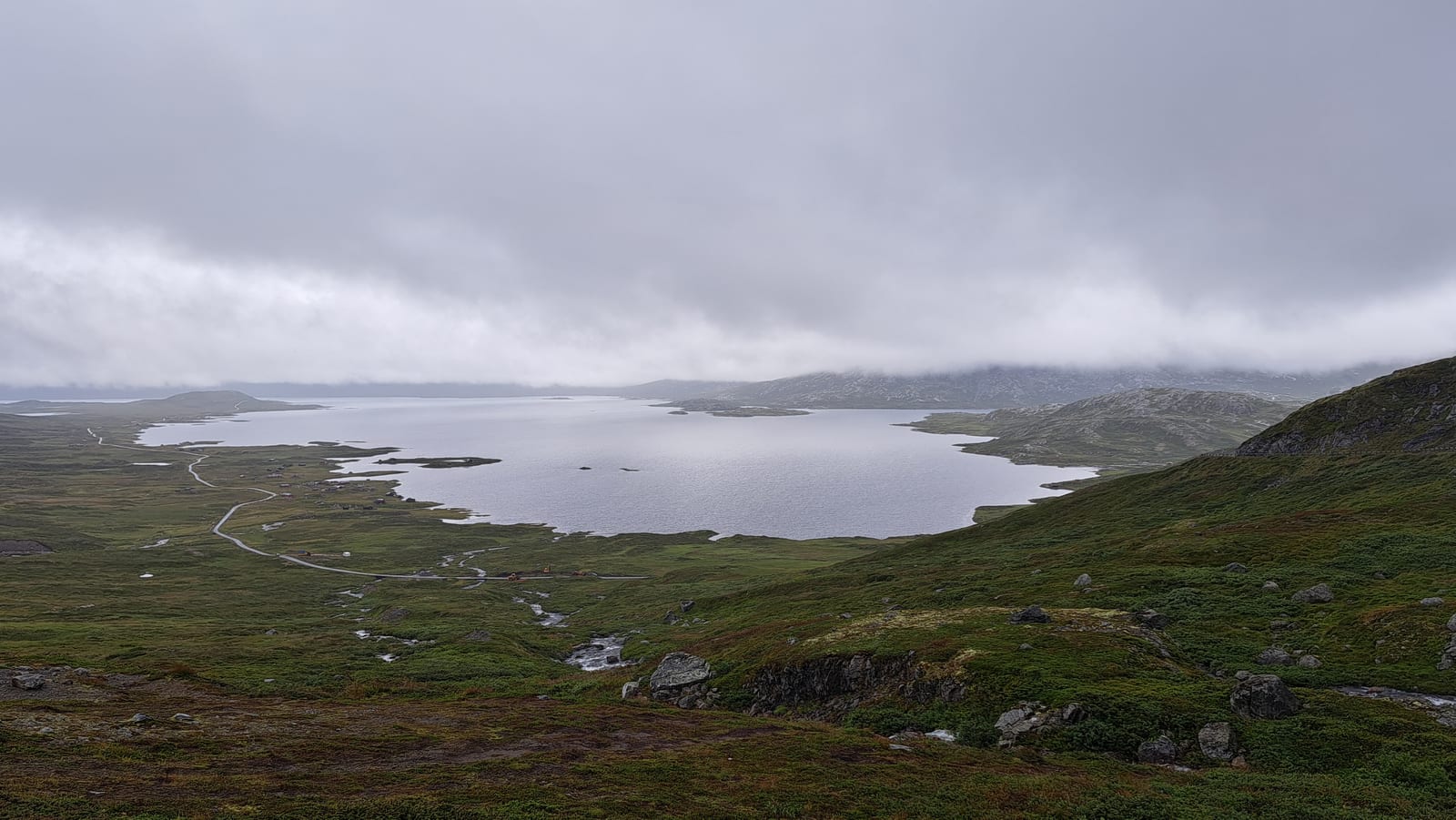
In the end, bored and discouraged, we ducked into a restaurant in the middle of nowhere, open who knows why, since it was completely empty, and yet beautiful, and just as good as it was expensive, like everything else in Norway.
After lunching at leisure, since we had nothing else to do, we got back in the car feeling demoralized. And when we least expected it, there was the surprise. First a brown dot in the distance in the fog, then, as it drew closer, the wonder: a sizeable group of reindeer crossing the road right in front of us.
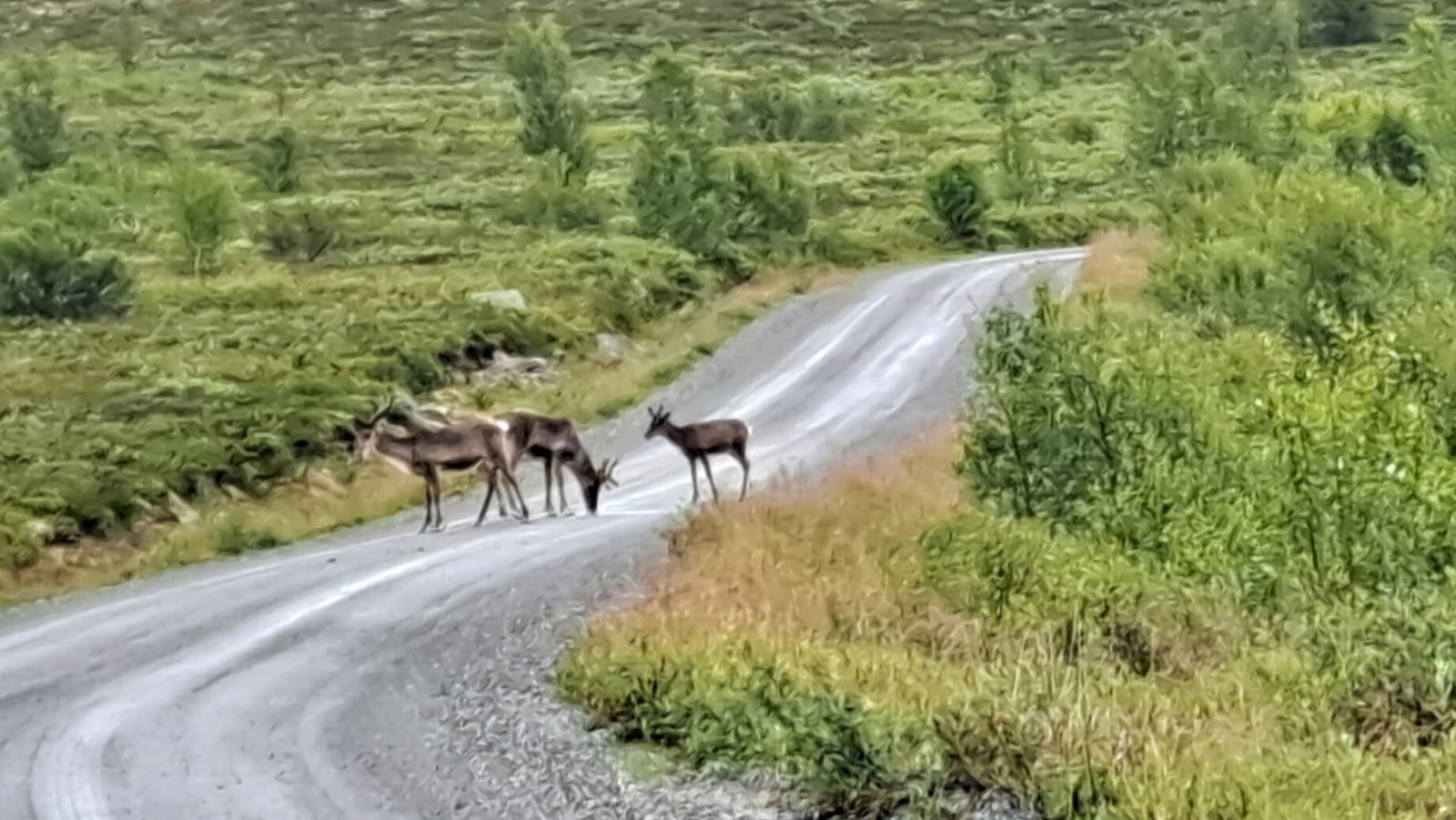
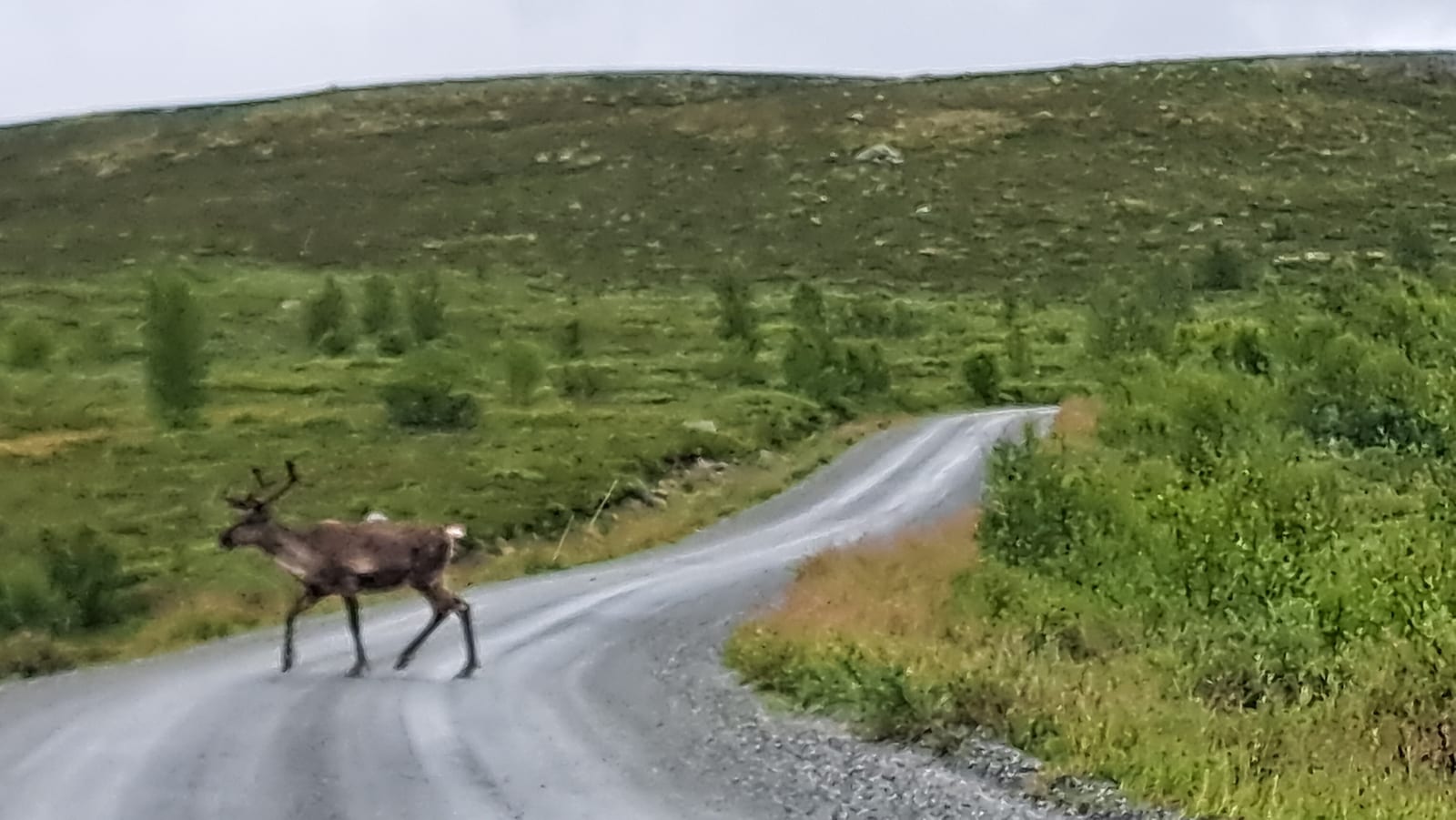
And just like that, a terrible day turns into a wonderful one in a single moment. We stayed to admire the animals until they vanished from sight, before getting back in the car.
And the day's surprises weren't over. We had read that near our lodge there was an area where it was easy to spot moose. So, after going back to our room and having dinner, we went out in the car to go on a moose safari, making use of the last hours of light, despite the gray sky and a bit of fog.
We weren't very optimistic, but we were lucky enough to spot several of them. Unfortunately the light conditions weren't at all suited to capturing them on camera, and we had to settle for seeing them with our own eyes.
For a day that had started so badly, the ending had been decidedly surprising.
Day 10 — Hotel California on the Glitreberget
Today's plan called for starting to close the loop, heading southwest, to return toward Bergen, skirting the Hardangervidda, and spending the night in Geilo, a famous Norwegian ski resort.
Against all expectations, along the way, another lucky encounter with a herd of reindeer to entertain us.
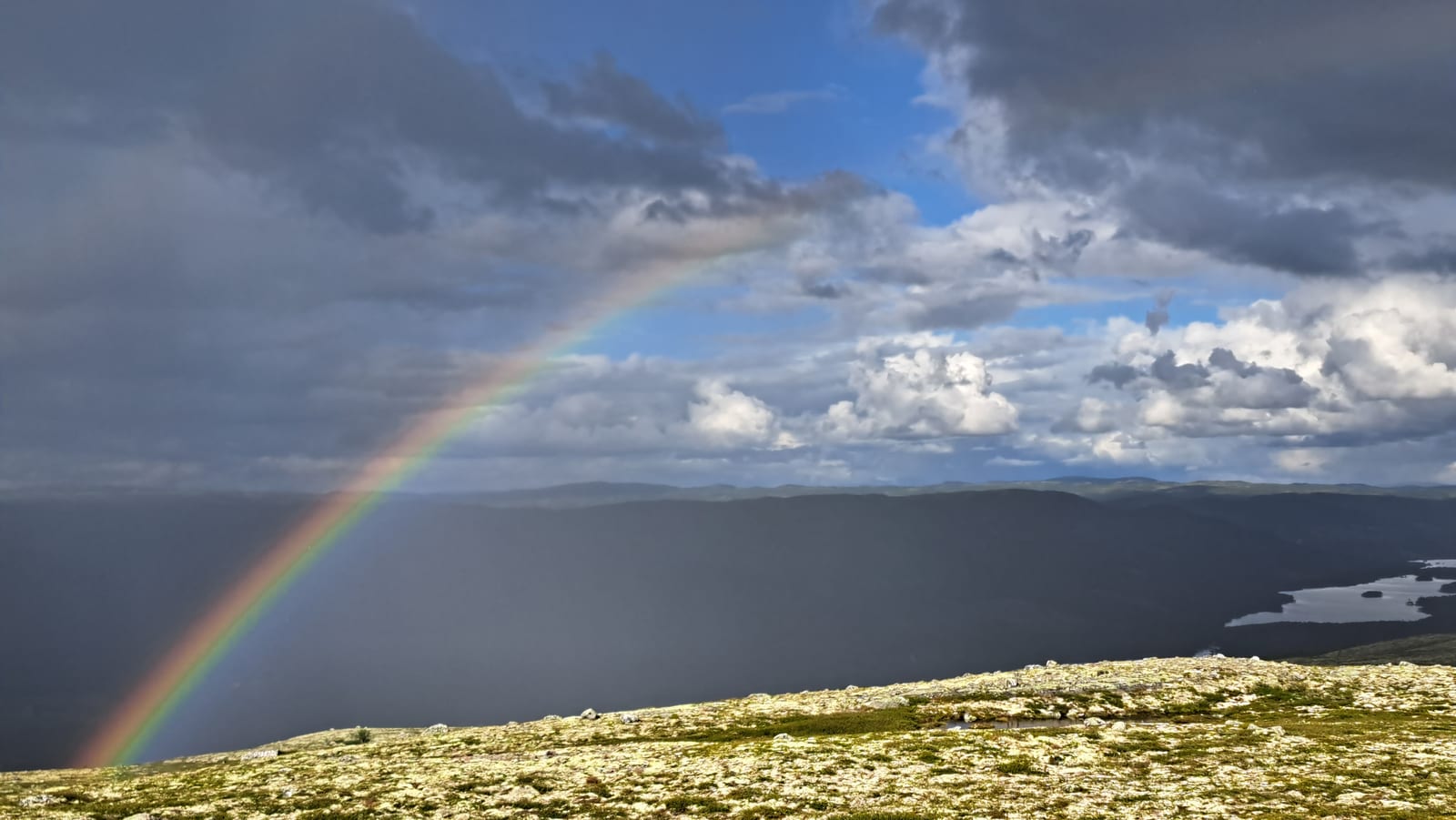
The route turned out to be longer than expected, but we still managed to treat ourselves to a nice hike to the Hotel California, a bivouac at the top of the Glitreberget, from which you enjoy a 360-degree view over the Hardangervidda, the Hallingskarvet, and the Numedal.
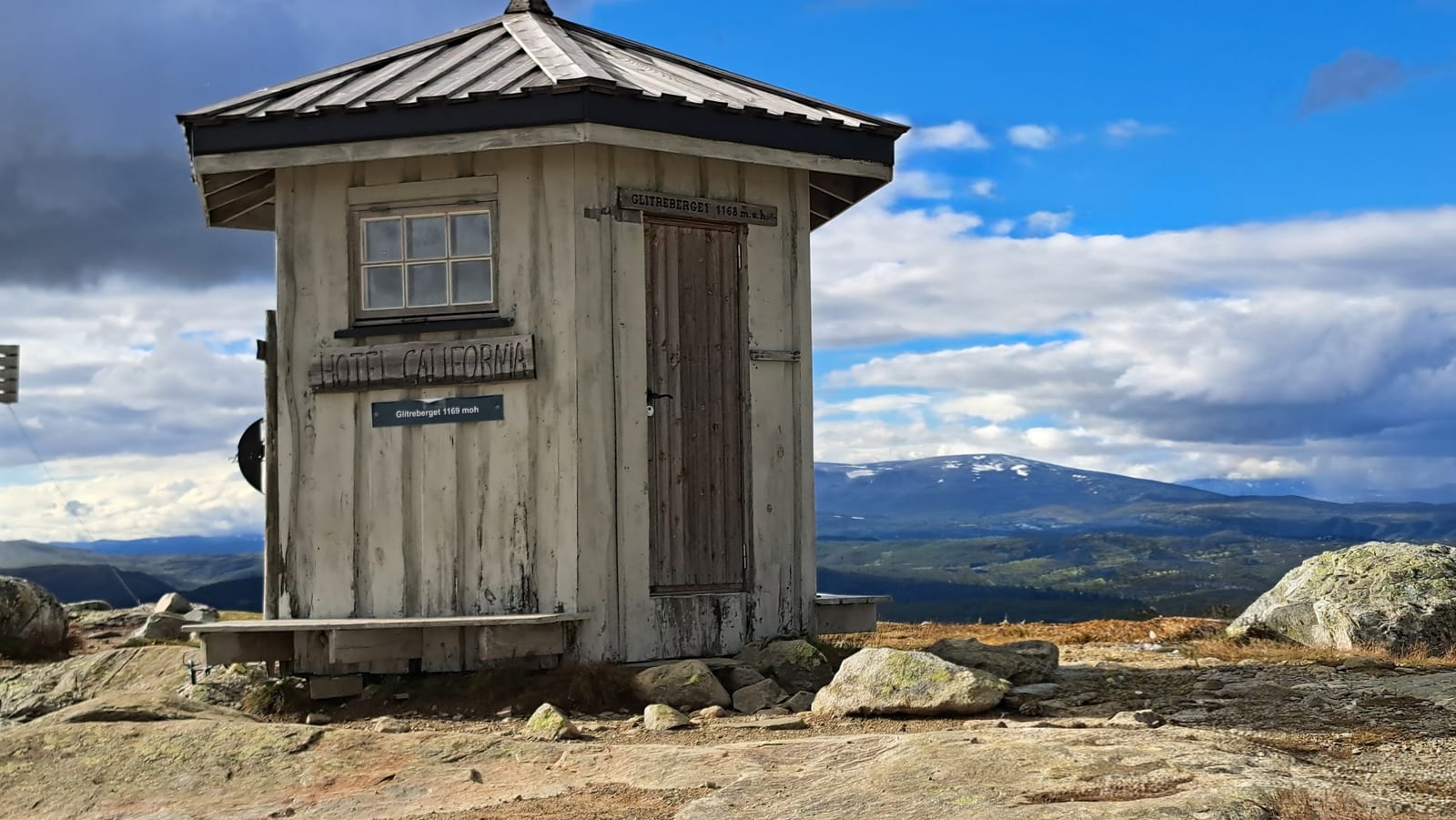
We set off in the sun, and reached the top just as a tremendous downpour hit. Luckily we were able to take shelter in the bivouac.
The rain didn't last long, the sun came back quickly, treating us to a beautiful rainbow as well, and getting us to our hotel fairly dry.
Day 11 — Hardangervidda, Vøringsfossen, and the Hardangerfjord
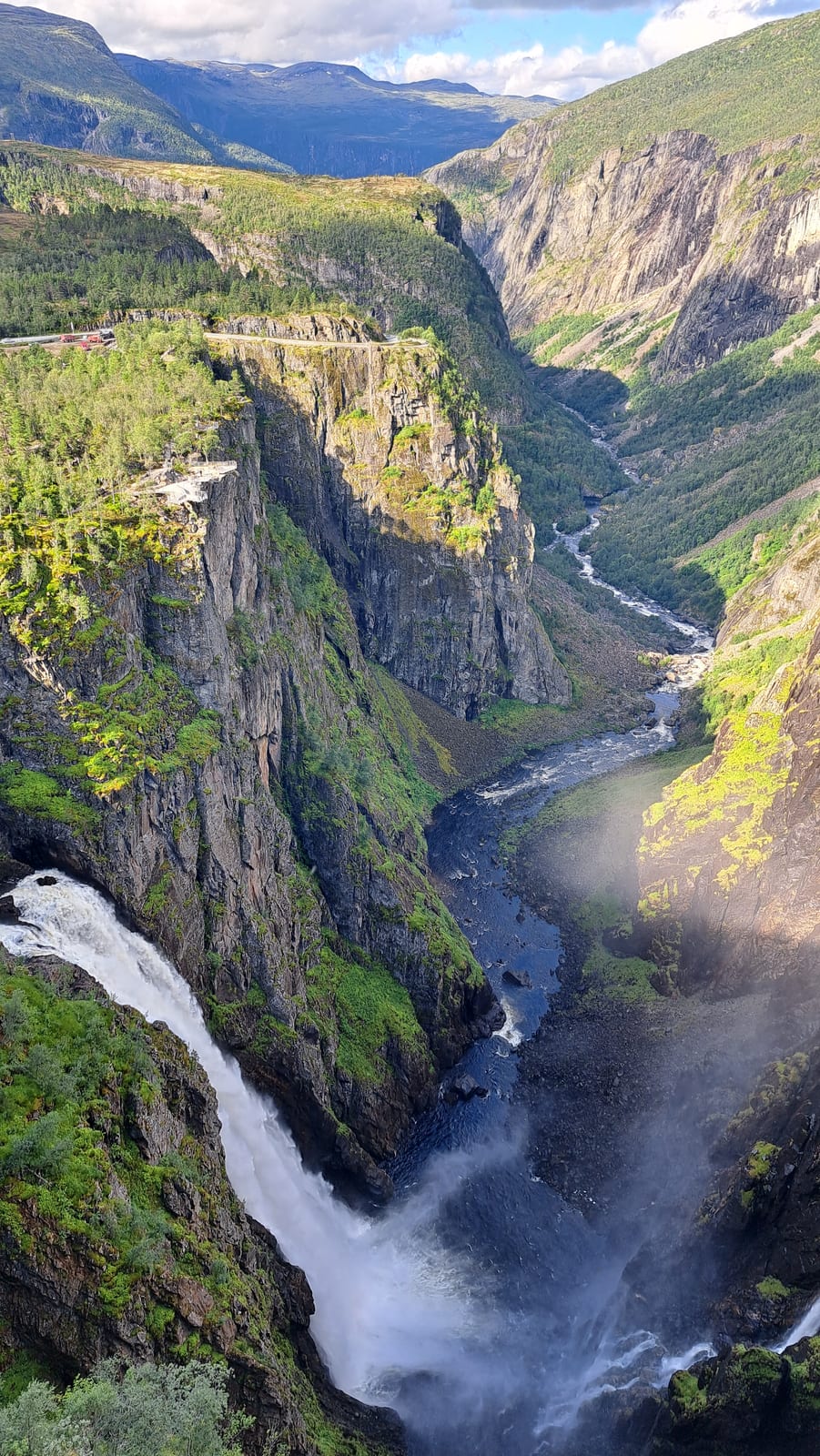
We set off early and in good spirits, buoyed by a forecast that promised sun. We crossed the whole Hardangervidda, through a harsh, bare landscape, despite its abundance of water, all the way to Vøringsfossen, a grand waterfall plunging from the plateau into the river far below. The area is equipped with scenic walkways that let you admire this wonder of nature from every angle.
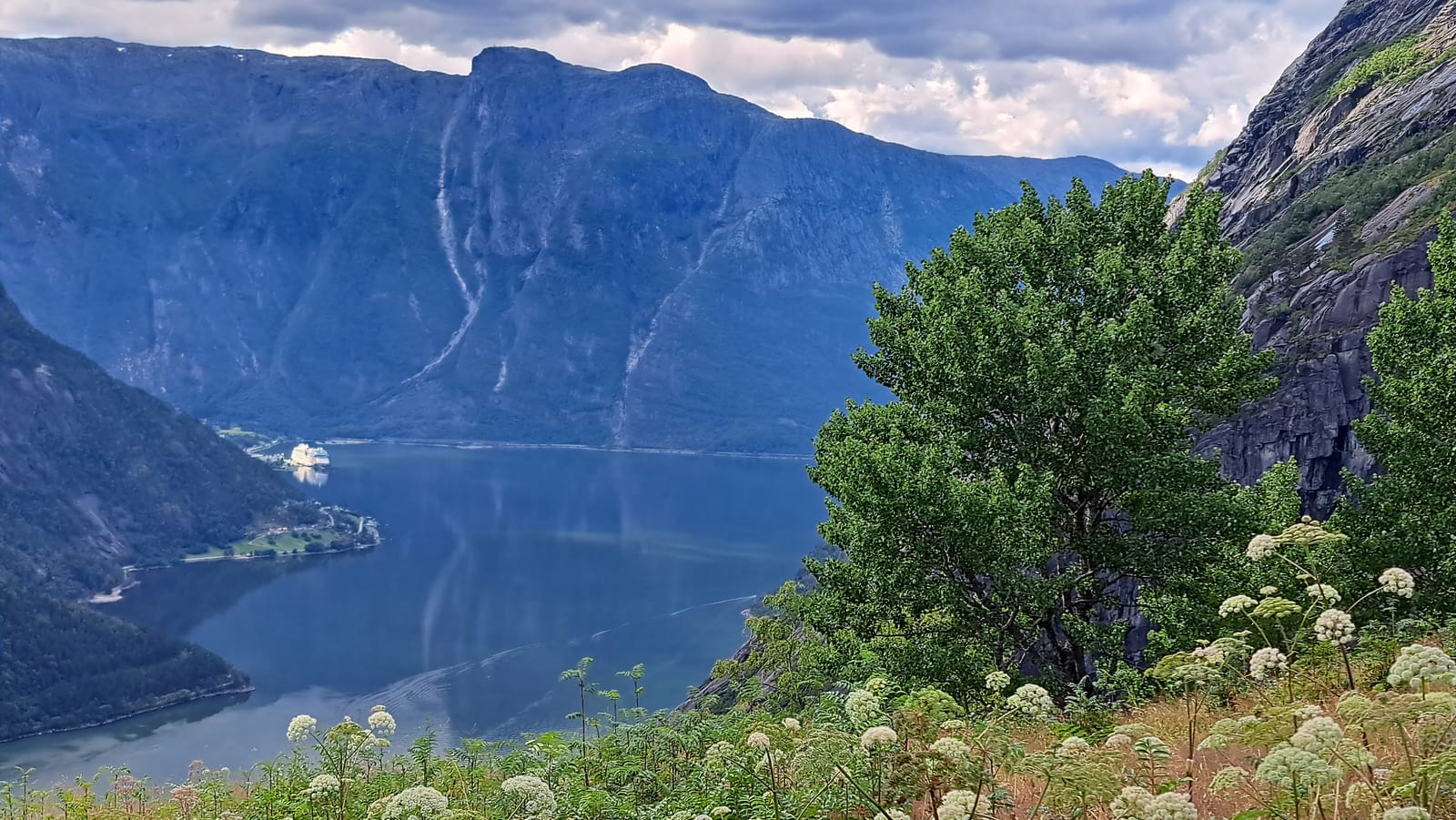
After completing the whole scenic route, we got back in the car heading toward Eidfjord. We took a short walk around town, and then headed straight for Kjeåsen, the clifftop farm, from which you look down over the Hardangerfjord.
Our destination for the day was Granvin, on the fjord. Along the way we crossed Norway's famous fruit-growing area, along the Hardangerfjord. An area where the mild microclimate created by the fjord allows crops unthinkable at these latitudes, and where a large share of Norway's fruit is grown.
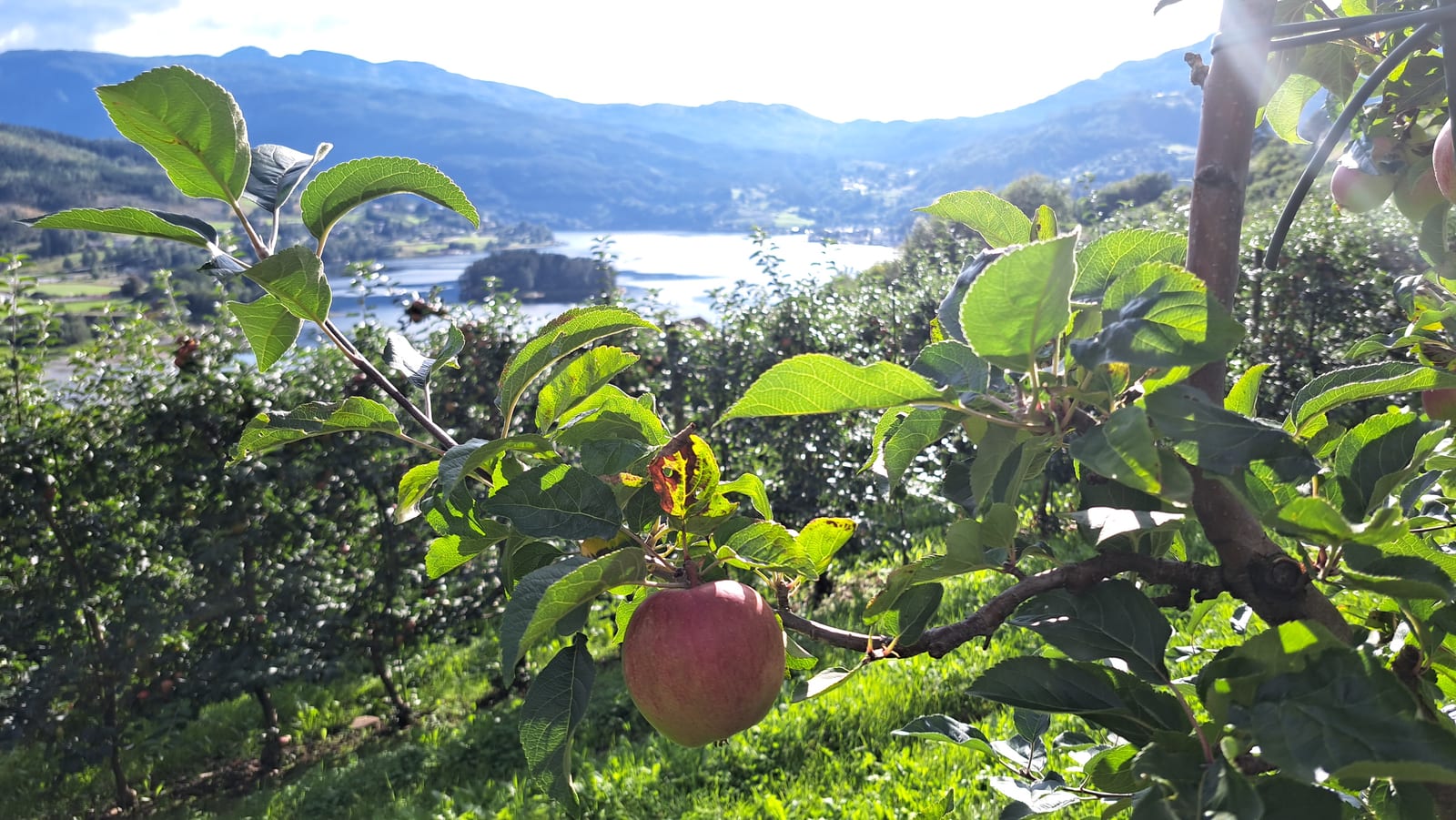
We were fascinated by the many fresh fruit stands, where you help yourself on the honor system and pay online.
We arrived in Granvin at dinnertime. Granvin has nothing special about it, yet, helped by daylight lasting well past ten in the evening, it managed to fill us with an absolute sense of calm.
Day 12 — Back in Bergen
Today we closed the loop and returned to Bergen, which we had completely skipped on our arrival. Ironically, in one of the rainiest cities in the world, we found good weather. We took the chance to go up Mount Fløyen and take a walk around the small lake of Skomakerdiket. From up there you get a beautiful view over the archipelago.
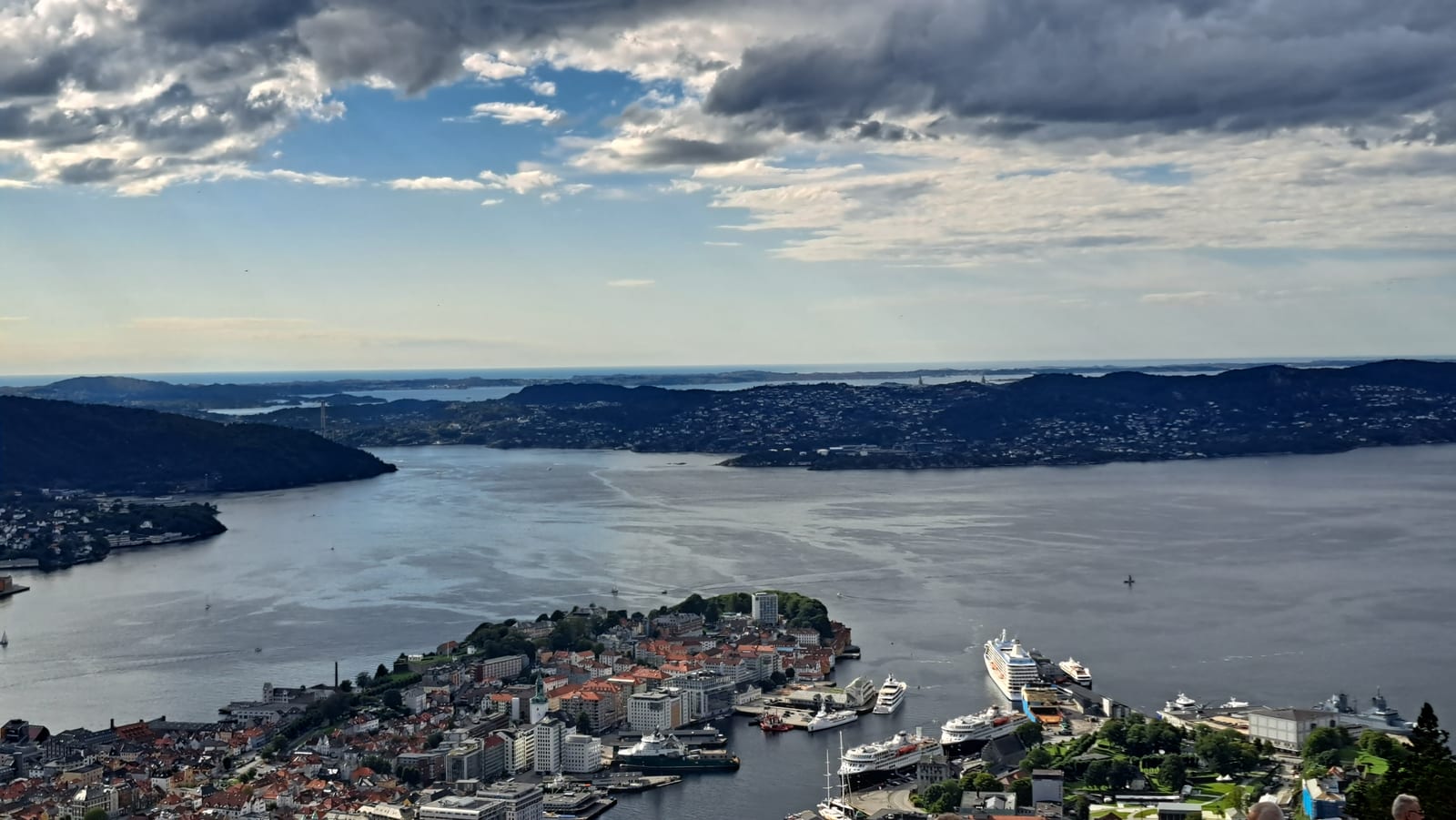
The city, though, shows its best side when you walk its streets, particularly around the famous Bryggen district and the fish market, with its stalls and restaurants.
It was Friday, and we happened upon a truly electric day. The waterfront was swarming with local young people celebrating, a kind of end-of-summer ritual: it was the day of Hallaien, the big concert that officially kicks off the academic year in Bergen, and thousands of students filled the streets. Some were dressed in bizarre outfits, many of them well into the celebrations.
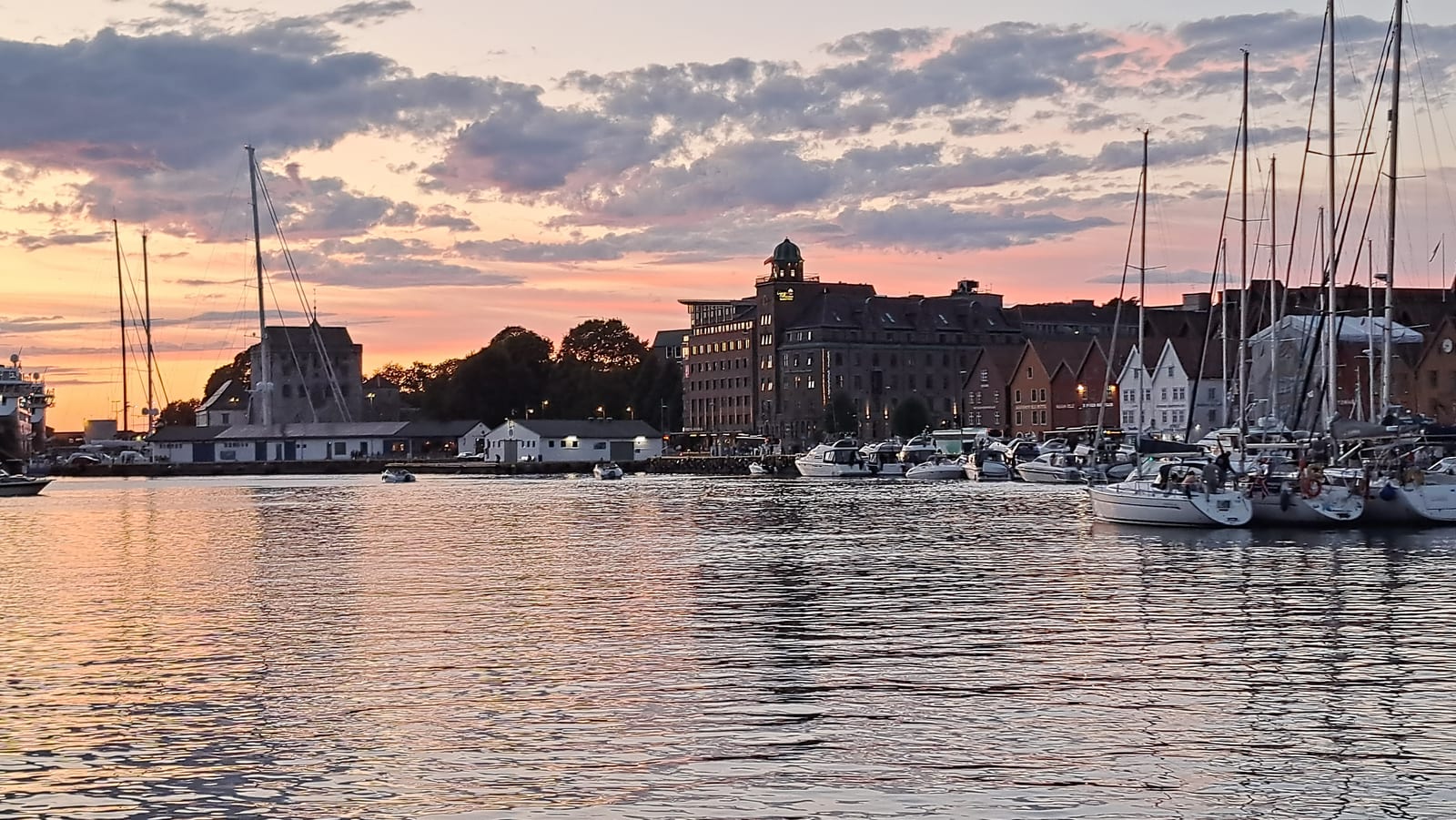
We aren't big fans of cities and crowded places, but if you're traveling through Norway, this one is truly not to be missed.
Day 13 — Bryggen at dawn and the train to Oslo
We got up early, happy to still find the sun, to take a walk around Bryggen in the early morning light, and above all without the crowds from the night before, and take a few photos. Getting lost in the little lanes of this district really has something to it.
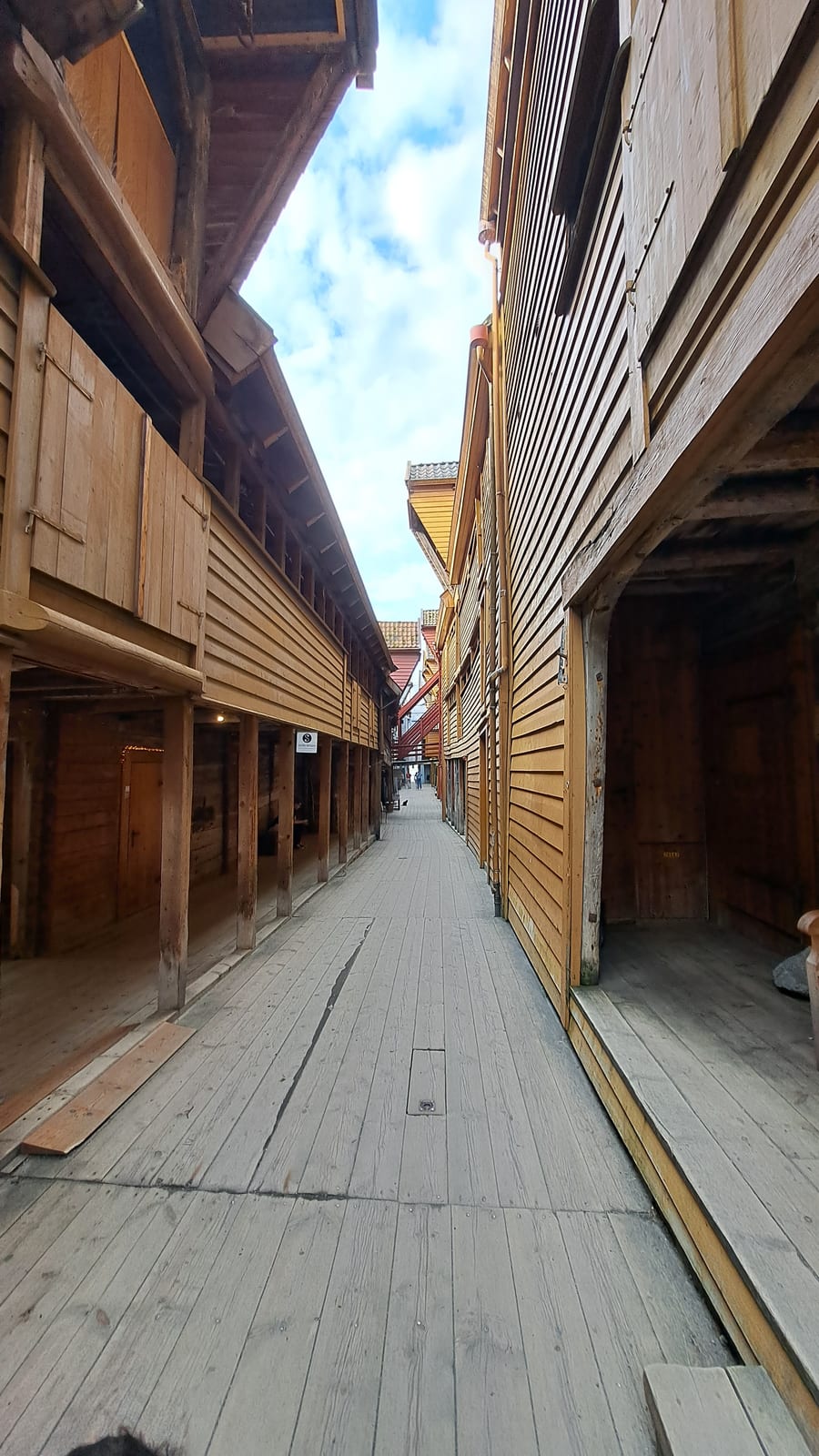
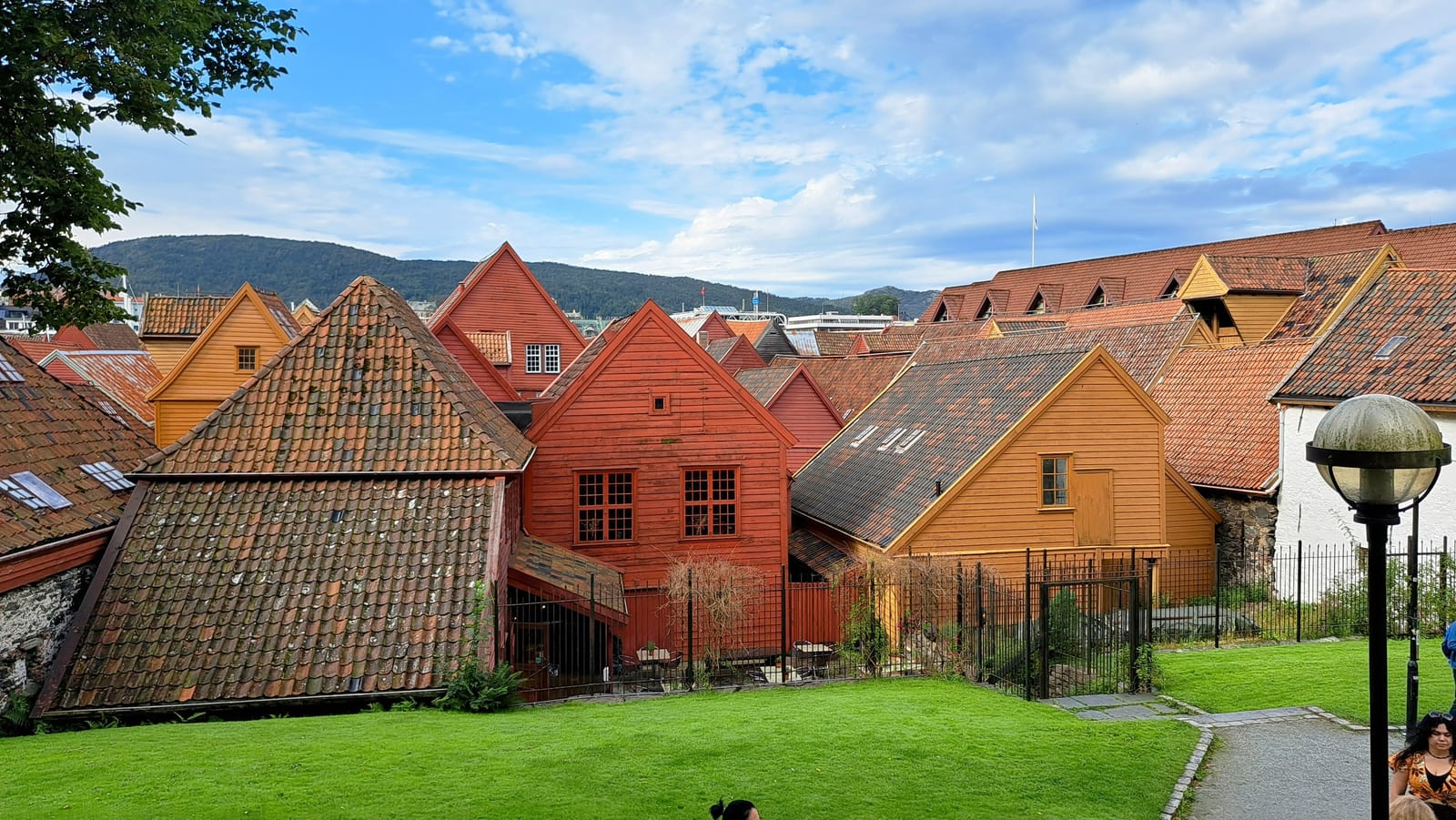
Later in the morning we had to head over to the station to catch the train to Oslo, and we took the chance to walk there, strolling through the streets of downtown, every bit as pleasant as Bryggen.
The Bergen-Oslo line is described in many guidebooks as one of the most beautiful rail journeys in the world. We, frankly, were left a little disappointed. The route runs through tunnels for long stretches, and the open stretches aren't enough to overcome the tedium of a journey that, all told, takes nearly seven hours. In the end it felt to us like we'd lost a day.
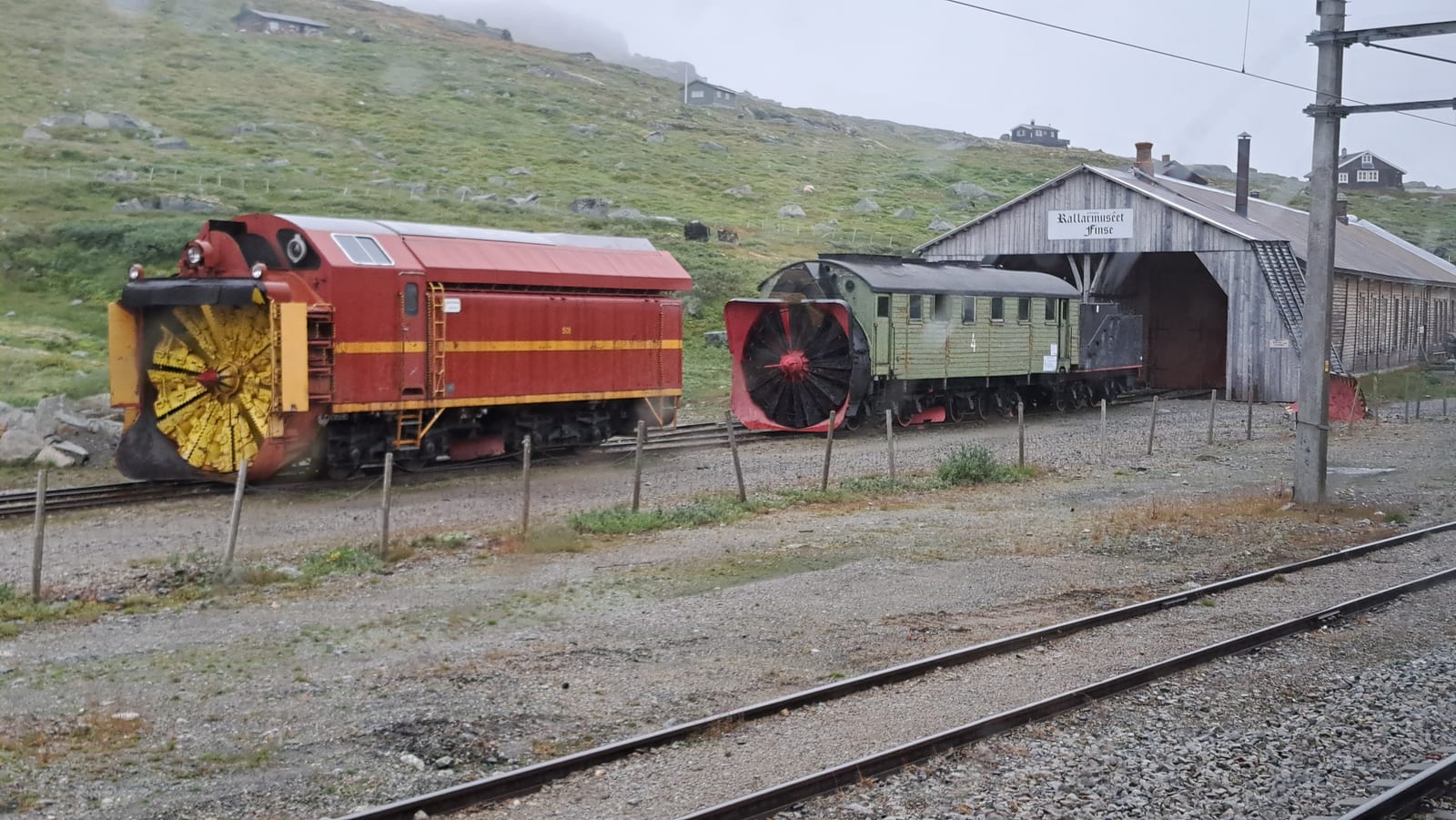
We arrived in Oslo at dinnertime, just in time for a walk through downtown, without much desire to visit the city. From the little we were able to see, Oslo is the cosmopolitan capital we had expected, and to round off the day, we went to eat at a sort of food hall full of international food stands.
Day 14 — Homeward
With a touch of sadness, but also with a great longing to get a taste of summer again, the kind we're used to in Italy, the day of our return had come. We didn't have much time, just enough for a short walk through downtown to the station to catch the train to the airport and say a final goodbye to this rainy vacation.
When we saw the first animals without the bus window between us, it was a real thrill.
Norway's nature is certainly overwhelming. For much of our trip we had the feeling of being in the high mountains, even though we were at the coast or just a bit higher up. It's clear that all this nature could leave city dwellers astonished. I have to admit that for us, as longtime Alpine hikers, it didn't always leave us awestruck the way we had expected before we left. Norway is a very large country, and we'll surely have to go back to visit its northern, more Arctic part, but we'll need to let a few years pass and forget all the rain we got.